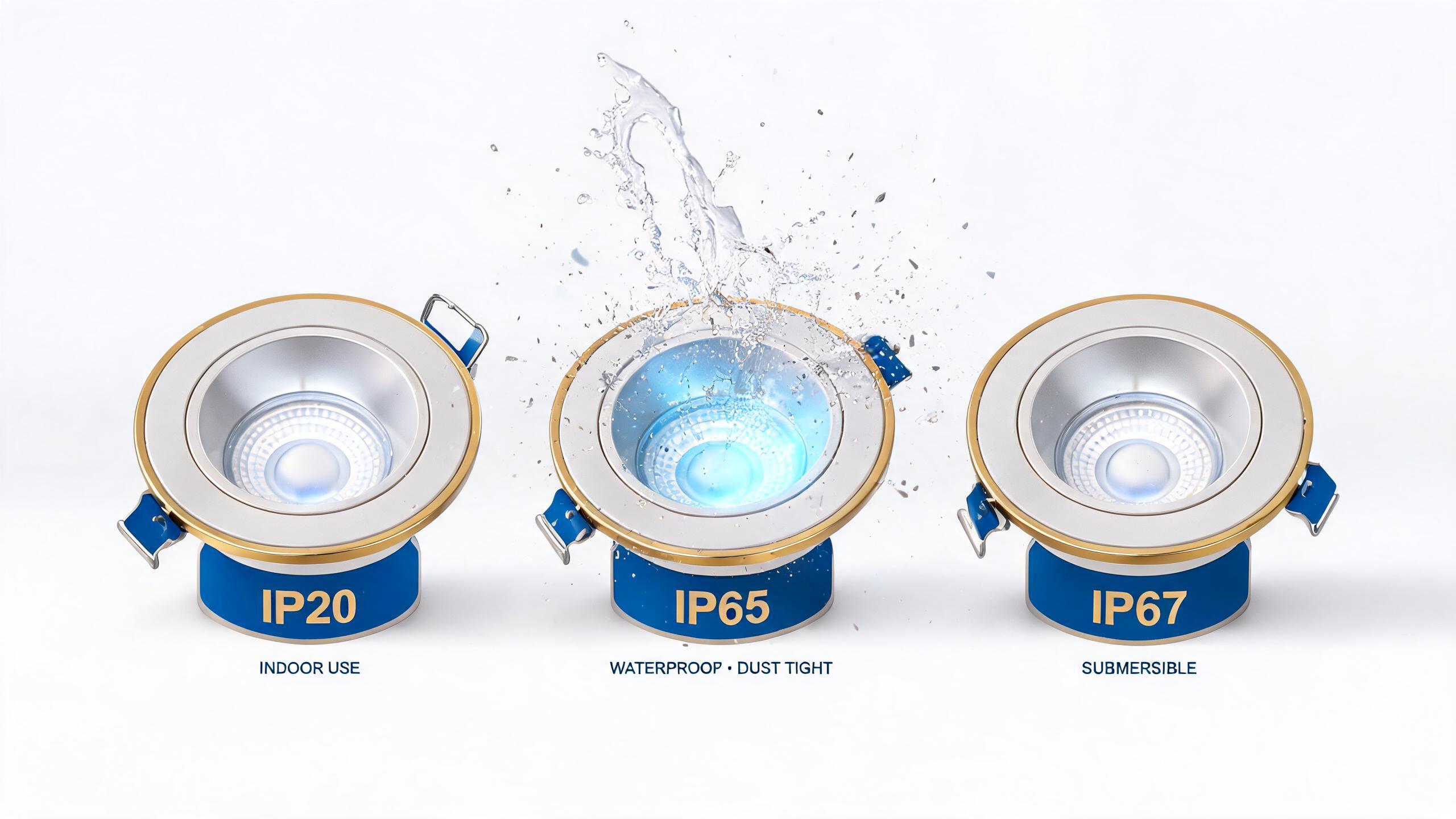
Every LED lighting spec sheet lists an IP rating. Most buyers glance at the number, assume higher is better, and move on. In the Middle East, that assumption costs money. The difference between IP54 and IP65 isn't a marketing detail — it's the line between a fixture that lasts 5 years and one that fails in 8 months.
What IP Ratings Actually Mean
IP stands for Ingress Protection. The standard — IEC 60529 — uses two digits. First digit: solid particle protection (dust). Second digit: liquid ingress protection (water). The two are independent ratings.
First Digit — Dust and Solids
| Rating | Protection | Practical Meaning |
|---|---|---|
| IP4x | 1mm objects | Protected against most wires, tools. Not dust. |
| IP5x | Dust-protected | Dust can enter but won't interfere with operation. Acceptable for indoor commercial. |
| IP6x | Dust-tight | No dust ingress whatsoever. Required for outdoor and dusty industrial environments. |
Second Digit — Water
| Rating | Protection | Practical Meaning |
|---|---|---|
| IPx4 | Splashing water | Rain-resistant from any direction. Minimum for covered outdoor areas. |
| IPx5 | Water jets | Low-pressure water jets from any direction. Good for car wash-adjacent areas. |
| IPx6 | Powerful water jets | High-pressure cleaning. Required for areas washed with pressure washers. |
| IPx7 | Temporary immersion (30 min, 1m) | Can survive flooding. Different test from IPx6. |
| IPx8 | Continuous immersion | Submersible. For underwater lights, fountains, and pool lighting. |
Here's the catch: IP67 doesn't automatically mean better than IP66. They test for different things. IP66 handles high-pressure jets. IP67 handles temporary submersion. A fixture rated IP66 might fail a submersion test, and an IP67 fixture might fail a high-pressure jet test. Know which hazard your application faces.
Which IP Rating for Which Middle East Application?
| Application | Minimum IP | Recommended | Why |
|---|---|---|---|
| Indoor offices / retail | IP20 | IP40 | No dust or water exposure. Focus on aesthetics. |
| Hotel lobbies / corridors | IP20 | IP44 | Cleaning staff may splash. Humidity in coastal areas. |
| Underground parking | IP54 | IP65 | Vehicle exhaust dust, humidity, occasional water leaks. |
| Warehouse interiors | IP54 | IP65 | Dust from operations, potential pressure washing. |
| Building facades | IP54 | IP65 | Wind-driven sand, rain. Coastal salt spray in Dubai/Doha. |
| Street and area lighting | IP65 | IP66 | Sandstorms, monsoon rain, humidity. The Gulf's default outdoor standard. |
| Swimming pool decks | IP65 | IP66 | Splash, chlorine, cleaning chemicals. |
| Underwater / fountain | IP68 | IP68 | Continuous submersion. No substitute. |
Dust: The Real Enemy in the Middle East
Everyone worries about water. In the GCC, dust kills more fixtures than moisture. Here's why.
Sandstorms — shamals — blanket the region from spring through autumn. Fine particulate matter (PM2.5 and smaller) penetrates joints, gaskets, and breath valves. It settles on LED chips and heat sinks, acting as thermal insulation. A fixture that ran at 65°C case temperature in clean conditions now runs at 85°C because the dust layer blocks convective cooling. The driver fails first, usually within 6-18 months.
IP5x allows dust to enter. IP6x doesn't. For any outdoor fixture in the GCC, the first digit must be 6. Not 5. Not "5x". Six.
For indoor industrial applications — warehouses, factories, parking garages — IP5x is marginally acceptable if the facility is climate-controlled. But if dock doors open regularly or ventilation pulls in outside air, specify IP6x.
Common IP Rating Mistakes in GCC Projects
"IP65 is enough for outdoor"
IP65 means dust-tight and protected against water jets. It's the baseline for outdoor, not the ceiling. For street lighting, facade lighting, and any fixture exposed to shamals, IP66 is safer because it handles high-pressure cleaning — which your maintenance team will eventually attempt.
"The IP rating covers the whole fixture"
Often it doesn't. Many manufacturers test the lens or housing for IP65 but use a driver enclosure rated IP20. The LED board is protected, but the driver — the component most likely to fail — isn't. Ask for the IP rating of the entire assembly, including driver compartment and cable glands.
"IP67 is better than IP66"
Not necessarily. If your fixture is on a building facade in Riyadh, it faces shamals and occasional heavy rain — not submersion. IP66 handles high-pressure cleaning, which your maintenance team will do. IP67's submersion rating is irrelevant. And some IP67 fixtures use potting resin that traps heat, shortening driver life in 45°C ambient conditions.
Forgetting the breath valve
Pressure differentials between inside and outside the fixture cause condensation. Quality outdoor fixtures include a GORE-TEX breath valve (PTFE membrane) that equalizes pressure while blocking water. If your fixture has no breath valve, condensation builds up inside — especially in humid coastal areas like Dubai, Doha, and Jeddah — and the IP rating becomes meaningless.
Not sure which IP rating your project needs?
Tell us your application and location. We'll recommend the right specification and send datasheets with full IP certification.
Get Specification HelpVerification: Don't Trust the Label
IP rating claims are easily fabricated. To verify:
- Request the IEC 60529 test certificate from an accredited lab (TUV, SGS, Intertek)
- Check that the certificate covers the complete fixture assembly, not just the housing
- For Saudi projects, ensure the IP rating appears on the SABER registration
- Ask for photos of the cable gland sealing — this is the most common failure point
- Verify the breath valve exists if the fixture will be used in coastal or humid areas
A manufacturer who provides this documentation without hesitation has engineered for the rating. One who hesitates has printed a number on a spec sheet.
Summary: IP Rating Selection for GCC Projects
- Indoor commercial (offices, retail, hotels): IP20-IP44 sufficient
- Underground parking, warehouses: IP54 minimum, IP65 recommended
- All outdoor (facades, streets, landscapes): IP65 minimum, IP66 strongly recommended
- Poolside, splash zones: IP66 minimum
- Underwater, fountains: IP68 only — no substitutes
- Always verify: Full-assembly IEC 60529 certificate, cable gland sealing, breath valve presence
Get the IP rating right and your fixtures survive shamals, humidity, and pressure washing. Get it wrong and you'll be replacing them after the first sandstorm season.