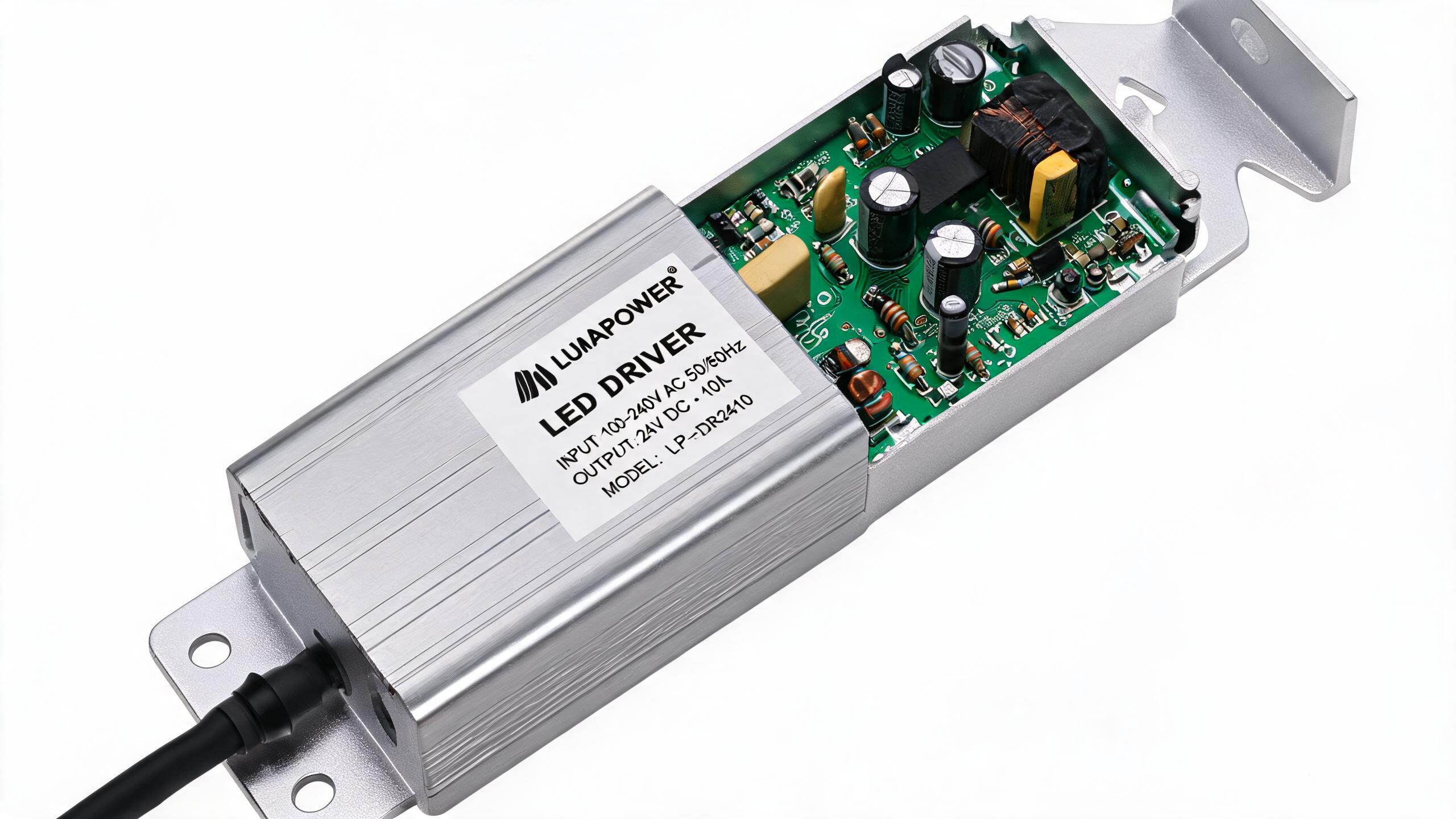
LED chips last 50,000 to 100,000 hours. That's the spec sheet number. In reality, most commercial LED fixtures fail at 8,000 to 15,000 hours. The LED chips are fine. The driver died.
The driver is the power supply that converts AC mains voltage to the regulated DC current the LED chips need. It's the most complex component in the fixture, the most sensitive to heat, and the most likely to fail. A quality driver costs 30-40% of the fixture's total BOM. A cheap driver costs 12-15%. Guess which one suppliers cut corners on to win your bid.
Why Drivers Fail: Three Killers
1. Capacitor Degradation (The #1 Cause)
Electrolytic capacitors are the weakest link. They degrade faster at higher temperatures — the Arrhenius equation means every 10°C increase halves capacitor life. A capacitor rated for 10,000 hours at 105°C lasts only 2,500 hours at 125°C. In a GCC warehouse with 45°C ambient, the internal driver temperature reaches 70-85°C. The math gets worse from there.
Quality drivers use Japanese-brand capacitors (Rubycon, Nichicon, Nippon Chemi-Con) rated at 105°C minimum. Budget drivers use Chinese-brand capacitors rated at 85°C. The difference shows up 18 months after installation, when fixtures start flickering or dying.
2. Thermal Management
The driver generates heat. If it's potted in resin inside a sealed enclosure with no thermal path to the fixture body, heat builds up until components fail. Quality drivers use aluminum PCB substrates or thermal pads that conduct heat to the fixture housing, which acts as a secondary heat sink.
3. Surge and Voltage Spikes
GCC power grids, particularly in industrial zones and new development areas, experience voltage transients. A single 6kV spike can destroy a driver's MOSFET and rectifier. Quality drivers include built-in surge protection (MOV + gas discharge tube). Budget drivers include a single MOV that degrades with each spike until it stops protecting anything.
Constant Current vs Constant Voltage
Most commercial LED fixtures use constant-current drivers. The driver regulates current (measured in mA) rather than voltage. LED chips are current-driven devices — exceeding rated current by even 10% shortens lifespan dramatically.
| Type | Best For | Typical Current | Pros |
|---|---|---|---|
| Constant Current (CC) | Downlights, spotlights, high bays | 350-700mA | Stable light output, consistent brightness across fixtures |
| Constant Voltage (CV) | LED strips, linear runs | 12V or 24V | Easy to cut and join, flexible lengths |
For panel lights, linear lights, and strip applications where fixtures link together, constant voltage is standard. For everything else — downlights, spotlights, high bays, flood lights — constant current is what you want.
What to Check in a Driver Spec Sheet
1. Power Factor (PF)
PF measures how efficiently the driver draws power from the grid. PF ≥ 0.9 is mandatory for commercial projects in most GCC countries. PF below 0.9 means your electrical system is carrying reactive load that wastes energy and may trigger utility company penalties.
Quality drivers: PF ≥ 0.95. Budget drivers: PF 0.5-0.7. The difference matters on a 300-fixture project.
2. THD (Total Harmonic Distortion)
THD measures electrical noise the driver injects back into the grid. High THD causes interference with other equipment and can trip circuit breakers. EN 61000-3-2 limits THD to 20% for lighting equipment. Quality drivers achieve <15%. Budget drivers often exceed 25%.
3. Tc Rating (Case Temperature)
The maximum temperature the driver's case is designed to operate at. This is the most important number for Middle East projects. A driver with Tc 65°C means the case can reach 65°C without voiding the warranty. In a 45°C ambient warehouse, the driver case typically runs 20-30°C above ambient — so 65-75°C. A driver rated Tc 55°C fails at 55°C case temperature, which you'll hit within hours.
Specify Tc ≥ 65°C for indoor commercial, Tc ≥ 70°C for industrial, and Tc ≥ 75°C for outdoor in GCC conditions.
4. Surge Protection Level
| Level | Protection | Application |
|---|---|---|
| 2kV | Basic | Indoor commercial, stable grid |
| 4kV | Standard | Industrial, moderate grid instability |
| 6kV | Enhanced | Outdoor, GCC industrial zones |
| 10kV | Maximum | Outdoor, known grid instability, remote areas |
For GCC projects, 4kV minimum. For outdoor lighting in industrial areas or remote locations, 6-10kV.
5. Lifetime (L70 for Driver)
LED chips have L70 ratings (70% brightness at X hours). Drivers have their own lifetime rating. A quality driver is rated for 50,000+ hours at Tc. A budget driver might rate 30,000 hours — but only at 25°C ambient, which is meaningless in the Middle East.
Ask for the driver lifetime curve at the actual operating temperature — not the datasheet number at 25°C.
The Driver Brand Hierarchy (Practical Guide)
In the Chinese LED export market, drivers fall into tiers:
- Tier 1 (Premium): Mean Well, Inventronics, SOSEN, Lifud — recognized brands with full datasheets, global warranty, and traceable serial numbers. Cost 30-50% more but backed by actual engineering.
- Tier 2 (Mid-range): Driver-IC, Fulongsheng, and similar factories with internal R&D. Datasheets are usually available but less detailed. Acceptable for most commercial projects.
- Tier 3 (Budget): Generic drivers with no brand marking, no datasheet, no warranty. Often labeled with inflated specs. These are the drivers that fail at 8,000 hours.
When a supplier quotes a fixture price that seems too good to be true, the driver is almost always where they saved money. A 200W UFO high bay with a Tier 1 driver costs $55-75. The same fixture with a Tier 3 driver costs $28-35. The spec sheet looks identical. The difference shows up in year two.
Want to verify your fixture's driver quality?
Send us your spec sheet. We'll tell you what driver is inside, whether the specs are inflated, and what the real expected lifespan is in GCC conditions.
Get Driver AssessmentProcurement Checklist: Driver Specifications
- Driver brand stated explicitly (not "famous brand" or "imported")
- Capacitor brand and temperature rating (105°C minimum)
- Power factor ≥ 0.95
- THD < 15%
- Tc rating ≥ 65°C (indoor) / ≥ 70°C (outdoor/industrial)
- Surge protection ≥ 4kV
- Driver lifetime curve at actual operating temperature
- Dimming protocol specified (DALI, 0-10V, or none)
- Input voltage range 100-277V (for wide compatibility)
- IP rating of driver compartment (for outdoor fixtures)
Specify these ten items in your tender and you'll eliminate 90% of the low-quality drivers from your procurement. The remaining 10% will fake the documentation — which is why you always test a sample before placing a bulk order.
Lighting isn't about LED chips. It's about the power supply that feeds them. Get the driver right and everything else follows.