Outdoor lighting in the Middle East faces tougher conditions than almost anywhere else on earth. 50–60°C summer temperatures, intense UV radiation, sandstorms, high humidity on the coasts, and unstable power grids — all working against your LED flood lights 24 hours a day.
Whether you're outfitting a stadium in Riyadh, a parking lot in Dubai, a building facade in Doha, or a perimeter security project anywhere in the MENA region, the LED flood lights you choose need to perform when conditions are at their worst. This guide walks you through everything that matters — from IP ratings to thermal design, from optics to SASO certification.
LED Flood Light Applications in the Middle East
Flood lights are the most versatile outdoor lighting fixture, and the Middle East uses them across a huge range of projects. Here are the most common applications we see from our clients:
| Application | Typical Power Range | Key Requirement | Market Examples |
|---|---|---|---|
| Stadium & sports lighting | 300W – 1000W | High lumen output, precise optics | Saudi football stadiums, cricket grounds |
| Parking lot lighting | 50W – 200W | Wide beam, reliable operation | Mall parking, retail parks, mosques |
| Building facade lighting | 30W – 150W | Color options, beam control | Hotel facades, landmarks, mosques |
| Perimeter & security lighting | 30W – 100W | Reliability, low maintenance | Industrial sites, compounds, airports |
| Street & road lighting (flood type) | 50W – 200W | Long lifespan, energy efficient | City streets, highways, access roads |
| Landscape & garden lighting | 10W – 50W | Design, color temperature options | Resorts, parks, public spaces |
| Port & industrial outdoor | 200W – 500W | Durability, corrosion resistance | Jeddah Islamic Port, Jebel Ali Port |
Vision 2030 in Saudi Arabia and similar economic transformation plans across the GCC are driving massive growth in all of these categories. From the stadiums being built for major sporting events to the thousands of kilometers of new roads and the endless expansion of retail and hospitality — outdoor LED flood lighting is a growth market.
IP66 vs IP65: What's the Real Difference for Outdoor Use?
You'll see both IP65 and IP66 specified for outdoor LED flood lights. The difference matters more in the Middle East than it does in temperate climates. Here's what those ratings actually mean:
- IP65 — Dust-tight (6) + protected against water jets from any direction (5). Can handle direct spray from a hose nozzle but not sustained high-pressure washing or extreme dust storms.
- IP66 — Dust-tight (6) + protected against powerful water jets and heavy seas (6). Can withstand high-pressure washing and extreme weather conditions.
For most GCC outdoor installations, IP66 is the right choice. Here's why:
- Sandstorm intensity — A severe sandstorm can create airborne dust pressures that exceed what an IP65 seal is designed for. Fine sand particles can work their way past IP65 gaskets over time.
- Cleaning practices — Many outdoor lighting installations in the GCC are cleaned with high-pressure washers to remove sand and dust buildup. IP66 fixtures handle this without issue; IP65 fixtures may leak.
- Coastal corrosion — In coastal areas like Dammam, Jeddah, and the UAE coast, salt-laden humidity adds a corrosion factor. IP66 sealing with marine-grade aluminum or powder coating lasts significantly longer.
When comparing quotes, don't just look at the IP number — look at how it's achieved. A quality IP66 flood light uses silicone gaskets, properly sealed cable glands, and pressure equalization vents (also called "breathers") that prevent condensation buildup without letting water or dust in.
Heat Resistance: Why 60°C Rating Matters for Saudi Summer
Let's talk about the elephant in the room: heat. In July and August, daytime temperatures in Riyadh, Jeddah, and Kuwait City regularly exceed 45°C, and the surface temperature of a flood light housing sitting in direct sun can reach 70°C or more.
Most Chinese LED flood light manufacturers rate their products at 25°C or 35°C ambient. Those numbers are essentially useless for the Middle East. What you need to look for is:
Thermal performance criteria for MENA outdoor use:
- Maximum ambient temperature rating (Ta max) — Should be at least 50°C, preferably 55–60°C for unshaded outdoor installations.
- L70 lifespan at 50°C — The L70 (time to 70% lumen output) should be specified at the actual operating ambient temperature, not at 25°C.
- Driver temperature rating — The LED driver is usually the first component to fail in high heat. Look for drivers rated Ta 60°C minimum.
- Housing material — Die-cast aluminum is the standard. Thicker is generally better — more thermal mass means more heat dissipation.
- Coating — UV-stabilized polyester powder coating prevents the housing from discoloring and degrading under intense Middle East sun.
One thing many buyers miss: the color shift that happens when LEDs run hot. A flood light that produces clean 4000K neutral white at 25°C may shift toward yellow or green when the LED junction temperature hits 90–100°C. For architectural and facade lighting where color consistency matters, look for fixtures with MacAdam 3-step or better color binning, and verify that the color stays within spec at maximum operating temperature.
Optics: Beam Angle and Light Distribution Matter More Than Wattage
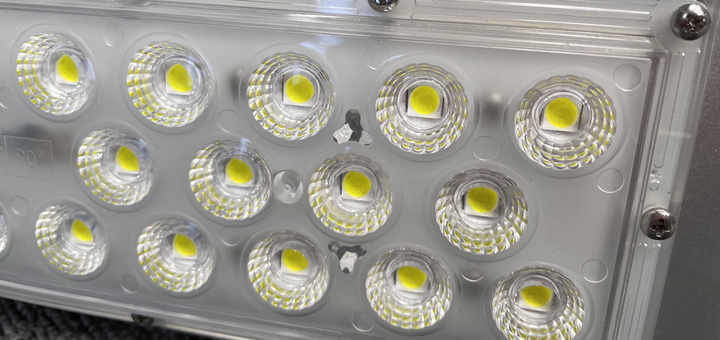
A 100W flood light with the wrong optics can produce worse results than a 50W flood light with the right beam pattern. For outdoor lighting projects, optical design is where the performance difference really shows.
Common beam angles for LED flood lights:
| Beam Angle | Type | Best For | Typical Applications |
|---|---|---|---|
| 10° – 20° | Narrow / spot | Long-throw, tall buildings, flag poles | High-rise facade, monument lighting |
| 25° – 40° | Medium / flood | Medium-distance projection | Building facades, sports lighting |
| 60° – 90° | Wide flood | Area lighting, close-range | Parking lots, perimeter, landscape |
| 100° – 120°+ | Very wide | Close-proximity area lighting | Underpass, wall washing, low parking |
For stadium and sports lighting, the optical requirements are much more stringent. You need precise beam control, minimal spill light, and uniform light distribution across the playing surface. This is where cheap flood lights fail catastrophically — they might put out a lot of total lumens, but the light goes everywhere it shouldn't and not enough where it should.
For serious projects, always ask for photometric data (IES files) and verify the lighting design in DIALux or AGi32. A supplier that can't provide IES files for their flood lights is not a supplier for professional projects.
SASO and SABER for Outdoor LED Lighting
Importing outdoor LED flood lights into Saudi Arabia requires the same SASO framework as indoor lighting, but with some additional considerations for outdoor products:
- IECEE/SIRC certificate — Required for all LED luminaires entering Saudi Arabia. Must cover the complete product (not just the LED module).
- Energy efficiency registration — Outdoor LED flood lights must meet SASO's energy efficiency requirements and display the energy label.
- SABER platform registration — Each model must be registered in the SABER system and have a valid CoC before customs clearance.
- IP rating verification — For IP65/IP66 rated products, the test report should come from an SASO-recognized lab.
- SASO 2902 compliance — The Saudi standard for LED luminaires covers both indoor and outdoor products.
For UAE and other GCC countries, G-Mark (GCC Conformity Marking) is becoming increasingly important. While it's not yet mandatory for all product categories in every GCC country, having G-Mark certification simplifies market access across the entire Gulf region and demonstrates that the product meets GCC safety standards.
Smart Lighting and Controls: The Growing Trend in GCC Outdoor Projects
Saudi Arabia's smart city initiatives (NEOM, Saudi Smart City program, etc.) are driving adoption of smart outdoor lighting across the Kingdom. Here's what buyers are increasingly asking for:
- Dimmable drivers — 0-10V, DALI, or PWM dimming to allow light level adjustment based on time of night or occupancy.
- Zigbee / Bluetooth mesh — Wireless control networks that let each flood light communicate with its neighbors, reducing wiring complexity.
- Photocells and motion sensors — Basic daylight harvesting and occupancy sensing for energy savings.
- CCTV integration — For security lighting projects, integration with surveillance camera systems.
- Central management systems — Software platforms that let you monitor and control every flood light from a central dashboard.
Starting in May 2026, SASO's Smart Lighting Energy Label 2.0 standard becomes compulsory for imported smart lighting products in Saudi Arabia. If you're specifying smart flood lights, make sure your supplier is already working on compliance — not just learning about it now.
Price Guide: LED Flood Lights from Chinese Manufacturers (2026)
As with high bays, there's a wide range in LED flood light pricing. Here's what you can expect at different quality tiers:
| Quality Tier | 50W | 100W | 200W | 300W | IP Rating | Warranty |
|---|---|---|---|---|---|---|
| Budget | $5–10 | $9–16 | $16–28 | $25–40 | IP65 (claimed) | 1–2 years |
| Mid-range commercial | $10–18 | $18–30 | $35–55 | $55–80 | IP66 verified | 3–5 years |
| Premium / industrial | $18–30 | $30–55 | $60–90 | $90–140 | IP66 + marine grade | 5–7 years |
For most Middle East outdoor projects, the mid-range commercial tier gives you the best value. You get IP66 verified construction, a reputable driver, decent thermal design, and 3–5 years of warranty — all at a price that makes your project economics work. Budget-tier flood lights rarely survive more than 2–3 years in GCC outdoor conditions, and the replacement cost (labor + lift rental + downtime) far exceeds the initial savings.
Common Failures and How to Avoid Them
Based on years of experience supplying outdoor lighting across the MENA region, these are the most common failure modes we see, and how to prevent them:
1. Driver failure (most common)
The LED driver fails within 12–24 months due to high operating temperatures and poor quality components. Prevention: Specify a known driver brand with a 60°C ambient rating. Avoid no-name drivers regardless of the price savings.
2. Water ingress
Water gets inside the fixture, usually through a poor-quality cable gland or degraded gasket, causing LED failure or short circuit. Prevention: Verify IP66 with test reports. Check gasket material (silicone, not foam) and cable gland quality.
3. Housing discoloration
The powder coating turns chalky or discolors after 1–2 years of intense sun exposure. Prevention: Specify UV-stabilized polyester powder coating with a minimum 80-micron thickness.
4. Lens yellowing
The clear PC lens turns yellow, reducing light output and changing color temperature. Prevention: Look for UV-stabilized polycarbonate or glass lenses. Glass lasts longer but is heavier and more fragile.
5. Corrosion
Coastal installations see corrosion on the housing and hardware after a few years. Prevention: Use marine-grade powder coating and stainless steel (304 or 316) mounting hardware for coastal projects.
Choosing the Right Chinese LED Flood Light Supplier
The Chinese LED flood light market is enormous and highly fragmented. There are thousands of factories, ranging from 5-person workshops to publicly listed corporations with 5,000+ employees. For Middle East buyers, the key is finding a supplier in the right size range — large enough to have proper quality control and certification support, but not so large that your order gets lost in the queue.
Here's what to look for in a supplier:
- MENA market experience — They should understand SASO, SABER, G-Mark, and be able to handle DDP shipping to major GCC ports.
- Product range — A supplier that makes only flood lights is fine, but one that also makes high bays, street lights, panel lights, etc. is more valuable as a one-stop partner.
- Certification support — They should have in-house compliance staff or work with certification consultants who know the GCC market.
- Sample availability — Being able to send 2–3 samples quickly for testing and approval is critical.
- MOQ flexibility — Different projects need different quantities. A supplier that can handle 50-piece orders and 5,000-piece orders is a long-term partner.
- Technical support — DIALux calculations, photometric files, wiring diagrams, installation guides — these are not extras, they're essentials.
Final Buying Checklist
Run through this before you place your LED flood light order for a Middle East project:
- ✅ IP66 minimum rating with third-party test report
- ✅ 50–60°C ambient temperature rating
- ✅ UV-stabilized housing and lens
- ✅ Reputable driver brand rated for high temperature
- ✅ 100–277V wide voltage with surge protection
- ✅ SASO IECEE/SIRC + SABER registration capability
- ✅ Photometric data (IES files) available
- ✅ L70 ≥ 50,000 hours at 50°C ambient
- ✅ 3+ year warranty (5 years preferred)
- ✅ Stainless steel mounting hardware option for coastal
- ✅ Supplier with MENA market references
- ✅ Free lighting design and calculation support
Need a Quote for Your Middle East Project?
Yakeen Lighting supplies commercial and industrial LED lighting across the MENA region. Send us your project specs — we'll respond with a detailed quotation within 24 hours.
Request a Free Quote