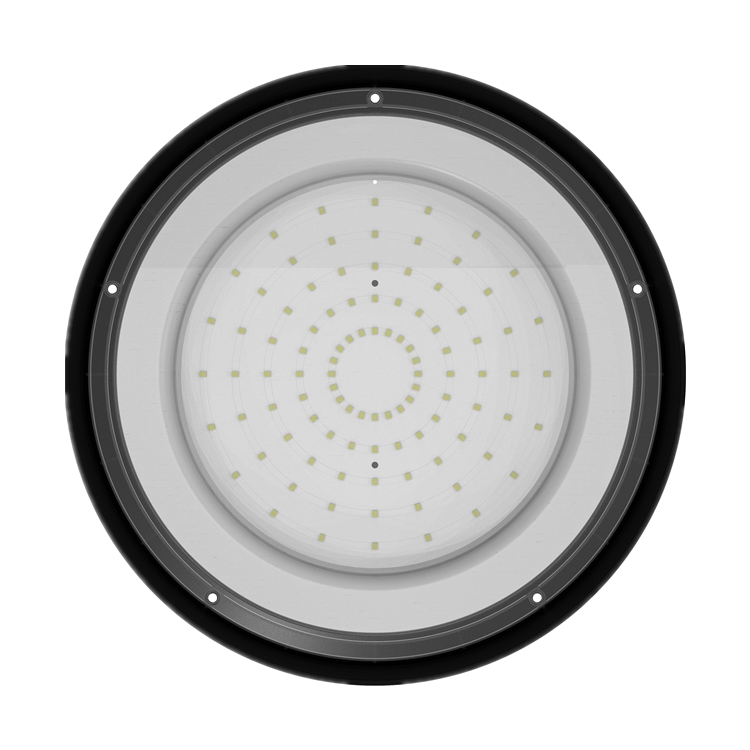
If you're an importer, MEP contractor, or facility manager sourcing LED high bay lights for a warehouse, factory, or logistics hub in Saudi Arabia, the UAE, or anywhere in the MENA region, this guide is for you. We've compiled everything we've learned from supplying industrial lighting to GCC projects over the years — from the real failure points in 50°C heat to how SASO certification actually works at customs.
LED high bay lights are the workhorse of industrial lighting. But not all high bays are built for Middle East conditions. A fixture that performs perfectly in Shanghai or Guangzhou may fail within 18 months in Riyadh or Dubai. The difference is in the details — thermal design, driver quality, ingress protection, and voltage tolerance.
UFO High Bay vs Linear High Bay: Which One for Your Project?
The two dominant high bay form factors on the market today are UFO (saucer-shaped) and linear (rectangular). Both have their place, but for Middle East industrial projects, the choice usually comes down to application and ceiling type.
| Feature | UFO High Bay | Linear High Bay |
|---|---|---|
| Best for | Warehouses, factories, high-ceiling open spaces | Supermarkets, retail, workshop aisles, office areas |
| Heat dissipation | Excellent — circular fin design maximizes surface area | Good — linear heat sink, adequate for most applications |
| Mounting height | 6m – 20m+ | 3m – 10m |
| Beam angles | 60°, 90°, 120° (common) | Wide distribution, linear pattern |
| IP rating typical | IP65 (dust-tight, water-jet protected) | IP40–IP54 (indoor only) |
| Middle East suitability | Excellent — handles dust and heat better | Good for clean, air-conditioned spaces |
For most GCC industrial projects — warehouses, factories, logistics centers, maintenance hangars — UFO high bays are the default recommendation. The circular heat sink design dissipates heat more efficiently at high ambient temperatures, and the IP65 rating means sand and dust won't penetrate the housing. In a region where sandstorms can coat every horizontal surface, an IP65-rated fixture is not a luxury — it's a reliability requirement.
Why IP65 Is Non-Negotiable for GCC Industrial Lighting
Let's be clear: IP40 or IP54 high bays have no business being installed in industrial spaces across Saudi Arabia or the Gulf. Here's why:
- Sand and dust intrusion — Fine desert sand gets into everything. An IP40 fixture (protected against solid objects larger than 1mm) will let sand particles inside, settling on the LED board and driver. Over 12–24 months, this causes thermal buildup, accelerated lumen depreciation, and eventual failure.
- Pressure washing — Many warehouses and factories in the GCC are cleaned with high-pressure water hoses. An IP65 fixture withstands direct water jets from any direction; an IP54 fixture will leak.
- Humidity cycles — Coastal locations like Jeddah, Dubai, and Doha experience high humidity. Temperature swings from night to day cause condensation inside poorly sealed fixtures, leading to corrosion and short circuits.
When comparing quotes from Chinese LED high bay manufacturers, always verify the IP rating with the test report, not just the product description. Some suppliers claim IP65 but only achieve it with the lens glued on — not with proper gasketing throughout the entire housing, including the wire entry and driver compartment.
Voltage: Why 100–277V Wide Input Matters in the Middle East
If you've been in the electrical trade in the GCC for more than a year, you know that the voltage on-site is rarely what the specification sheet says. Power quality varies significantly across the region, and grid instability is a real concern, especially in industrial zones and new development areas.
A high bay light with a 100–277V wide voltage input range handles all of these scenarios:
- Saudi Arabia — Nominal 220V/230V single phase, but can swing ±15%
- UAE and Qatar — 220–240V, generally more stable but with occasional sags
- Egypt and North Africa — 220V with frequent voltage drops and surges
- Industrial zones — Can experience harmonic distortion and voltage fluctuation from heavy machinery
More importantly, a wide-voltage driver with built-in 4kV surge protection survives the transient voltage spikes that happen when large equipment starts up or when lightning strikes nearby. In the GCC, where summer thunderstorms (though rare) can be intense and industrial equipment is power-hungry, surge protection is the difference between a fixture lasting 5 years and failing in 18 months.
Thermal Performance: The 50°C Test That Separates Quality From Junk
Here's the hard truth about LED high bay lights sold in the Middle East: most of them are derated in real-world conditions. A 150W high bay that produces 150W at 25°C ambient may only produce 110–120W at 50°C ambient. That's not a 10% loss — that's a 20–27% shortfall in light output on the hottest summer days, exactly when you need the light most because the days are longest.
What to look for in thermal design:
- Die-cast aluminum housing — Not stamped steel, not plastic. Aluminum dissipates heat fast and handles thermal cycling without fatigue.
- Cold-forged heat sink (premium models) — For high-power fixtures (200W+), cold-forged aluminum provides superior thermal conductivity compared to die-cast.
- Thermal interface material (TIM) — A proper thermal pad or thermal grease between the LED PCB and the heat sink. Some cheap factories skip this to save cost, and the light runs 15–20°C hotter as a result.
- Driver temperature rating — The driver should be rated for at least Ta 60°C (ambient). If it's only rated for Ta 45°C, it will derate heavily in the GCC summer.
When evaluating samples, ask the factory for the Tj (junction temperature) at 50°C ambient. Anything above 85°C Tj means the LEDs will degrade faster than the claimed L70 lifespan. A quality high bay should run at 70–80°C Tj at 50°C ambient.
SASO Certification and SABER Registration for LED High Bay Lights
Importing LED high bay lights into Saudi Arabia requires SASO compliance, and since 2020, all lighting products must go through the SABER electronic registration platform. Here's what you need to know as a buyer:
Key certification requirements:
- IECEE/SIRC certificate — The foundation document for SASO registration of lighting products. Must be issued by an SASO-recognized IECEE CB testing laboratory.
- Energy efficiency label — LED high bays must meet minimum efficacy requirements. As of 2026, the bar keeps rising — make sure your supplier's products test at least 140 lm/W system efficacy.
- SABER registration — Each product model needs a SABER registration with a valid CoC (Certificate of Conformity) before it can clear Saudi customs.
- SASO 2902 standard — The specific Saudi standard for LED luminaires. Includes requirements for safety, performance, and labeling.
Working with a Chinese LED high bay manufacturer that understands SASO and SABER procedures saves you weeks of delays at the port. At Yakeen Lighting, we pre-register our standard high bay models through SABER and can provide the CoC documentation before your shipment arrives, so customs clearance is smooth.
Power and Optical Selection by Application
Choosing the right wattage and beam angle is half the battle. Here's a quick reference based on common Middle East industrial applications:
| Application | Mounting Height | Recommended Power | Beam Angle | Target Lux |
|---|---|---|---|---|
| Small warehouse (storage) | 5–7m | 100–150W | 120° | 150–200 lux |
| Medium warehouse (picking) | 7–10m | 150–200W | 90° | 300 lux |
| Large distribution center | 10–15m | 200–240W | 60°–90° | 200–300 lux |
| Factory production floor | 6–10m | 150–200W | 90°–120° | 300–500 lux |
| Aircraft hangar / high bay | 15–25m | 240–300W | 30°–60° | 200 lux |
| Workshop / maintenance bay | 5–8m | 100–150W | 120° | 300–500 lux |
These are starting points, not final specifications. For any serious project, you should get a DIALux or Relux lighting calculation done based on the actual ceiling height, reflectances, and layout. If you don't have access to lighting design software, Yakeen Lighting provides free DIALux lighting calculations for our clients — just send us your floor plan and ceiling height.
Pricing: What You Should Expect to Pay (2026)
LED high bay prices from Chinese factories range widely, from under $15 for a 100W basic model to over $80 for a 200W premium industrial model. Here's how the market breaks down:
Price tiers for UFO LED high bays (FOB China, 2026):
| Quality Tier | 100W | 150W | 200W | Driver Brand | Warranty |
|---|---|---|---|---|---|
| Budget / economy | $12–18 | $16–25 | $22–32 | Unknown / no-name | 1–2 years |
| Mid-range (commercial) | $18–28 | $25–38 | $35–50 | Mean Well / SOSEN / Inventronics | 3–5 years |
| Premium (industrial) | $28–40 | $38–55 | $50–70 | Philips Xitanium / Tridonic / premium Mean Well | 5–7 years |
For most GCC industrial projects, the mid-range commercial tier offers the best balance of price and reliability. Look for a reputable driver brand (Mean Well, SOSEN, or Inventronics), die-cast aluminum housing, IP65 rating, and at least 130–140 lm/W system efficacy. Budget-tier fixtures may seem attractive on paper, but the failure rate in 50°C GCC heat is significantly higher, and you'll end up spending more on replacement labor than you saved on the purchase.
What to Check on a Sample Before Placing a Bulk Order
Before you commit to a container order of LED high bay lights, always order samples and test them. Here's our checklist:
- Weigh it — A 150W UFO high bay should weigh at least 3.5–4.5 kg. If it's lighter, the heat sink is too small and it will run hot.
- Thermal gun test — Run it for 4 hours in a hot environment (or an oven if you can) and measure the housing temperature. The surface should be hot but not untouchable — roughly 55–70°C at 50°C ambient is normal.
- Driver brand — Open the driver compartment and verify the driver brand and model. Cross-check the specs with the manufacturer's datasheet.
- IP gasket check — Inspect the gasket material. It should be silicone rubber, not foam, and it should be continuous with no gaps.
- Wire entry — Check the cable gland. It should be a proper IP65-rated gland, not a simple plastic bushing.
- Integration test — Test with your actual voltage (220V, 240V, whatever you use on-site) and measure the power draw with a watt meter.
Why Chinese LED High Bay Manufacturers Dominate the MENA Market
If you're comparing European brands against Chinese factories for Middle East projects, the math usually works out in favor of Chinese manufacturers — but only if you work with the right partner.
Here's why Chinese LED high bay suppliers are the go-to choice for most MENA buyers:
- Price advantage — 30–60% lower than comparable European brands, even with shipping and import duties factored in.
- Customization capability — Chinese factories can adjust wattage, beam angle, color temperature, housing color, and branding at MOQs that European brands won't touch.
- SASO/G-Mark support — Experienced Chinese lighting suppliers already have the certification infrastructure in place for the GCC market.
- Fast production — Standard models can ship in 7–15 days; custom orders in 20–30 days. European brands often have 8–12 week lead times.
- Full product range — You can source high bays, flood lights, downlights, panel lights, street lights, and everything else from one supplier, simplifying logistics and QC.
The key is working with a supplier that understands the Middle East market — not just a factory that makes lights and ships them worldwide. A supplier that knows SASO procedures, understands DDP shipping to Jeddah or Jebel Ali, and can advise you on which products actually hold up to the climate.
Final Checklist Before You Buy
Before you sign the PO for LED high bay lights for your Middle East project, run through this list:
- ✅ IP65 minimum rating (IP66 for washdown areas)
- ✅ 100–277V wide voltage input with surge protection
- ✅ Die-cast aluminum housing with proper thermal design
- ✅ Reputable driver brand (Mean Well, SOSEN, Inventronics, or equivalent)
- ✅ L70 ≥ 50,000 hours at 50°C ambient (not 25°C)
- ✅ SASO IECEE/SIRC certificate and SABER registration capability
- ✅ 3–5 year warranty minimum (5 years preferred for industrial)
- ✅ System efficacy ≥ 130 lm/W (140+ lm/W for energy-efficient models)
- ✅ Supplier with MENA market experience and local references
- ✅ Free DIALux lighting design support for project layouts
Need a Quote for Your Middle East Project?
Yakeen Lighting supplies commercial and industrial LED lighting across the MENA region. Send us your project specs — we'll respond with a detailed quotation within 24 hours.
Request a Free Quote