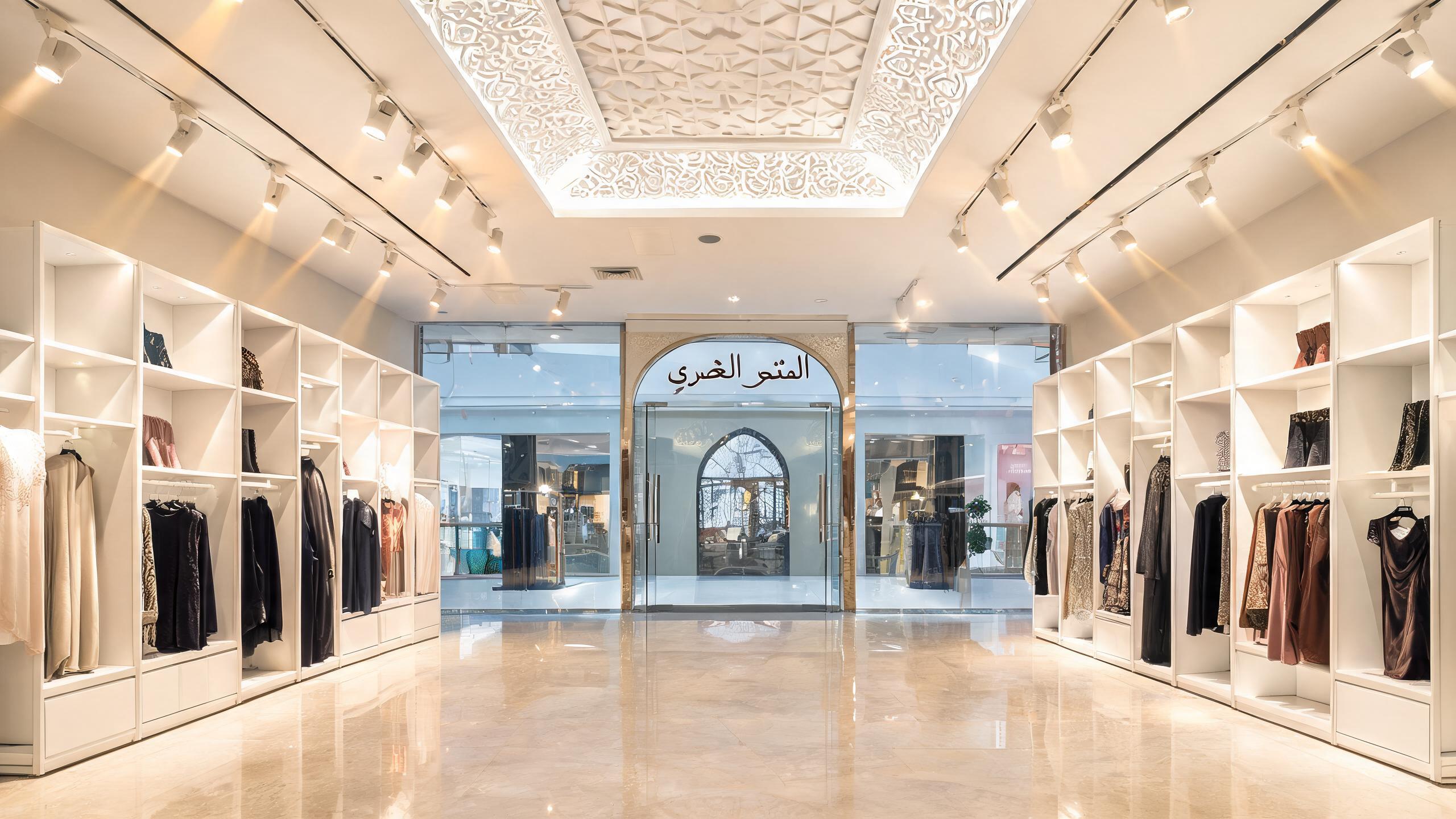
Walk into any Apple Store. Notice how the products seem to glow. That's not magic — it's lighting design. Specifically, it's narrow-beam track lighting positioned to create 3:1 contrast ratios between product and background.
Now walk into a typical retail store in a Riyadh or Dubai mall. Flat, even illumination. Everything visible, nothing highlighted. Products look the same as the shelf they're sitting on. That's the difference between lighting that sells and lighting that just lights.
Track lighting is the most flexible retail lighting tool. It lets you move, add, and adjust fixtures without rewiring. But flexibility without knowledge produces bad results. This guide covers the specifications that matter for GCC retail.
CRI: The Number That Determines Whether Colors Look Real
CRI (Color Rendering Index) measures how accurately a light source renders colors compared to natural sunlight. Scale: 0-100. Higher is better. The number that matters for retail:
| CRI | Application | Effect |
|---|---|---|
| 70-79 | Warehouse, industrial | Colors look muted. Fine for logistics, bad for retail. |
| 80-85 | Budget retail, supermarkets | Colors look acceptable. Shoppers can see products but they lack vibrancy. |
| 90+ | Premium retail, boutiques, jewelry | Colors pop. Reds look red, gold looks gold, fabric textures visible. |
| 95+ | Luxury, art galleries, museums | Near-perfect color fidelity. The standard for high-end retail. |
For any retail application in the GCC, CRI 90+ is the floor. If you're selling clothing, jewelry, cosmetics, or food, CRI 95+ pays for itself in perceived product quality. The cost difference between CRI 80 and CRI 90 LED chips is $2-4 per fixture. On a 50-fixture store, that's $100-200. One additional sale recovers it.
Color Temperature: Warm or Cool?
Color temperature (CCT, measured in Kelvin) affects mood and perception. Different retail categories need different CCT:
| Store Type | CCT | Why |
|---|---|---|
| Jewelry / Watches | 3000K | Warm light makes gold and diamonds glow. Cool light makes silver look clinical. |
| Fashion / Apparel | 3000K-3500K | Skin tones look healthy. Fabric colors render warm and inviting. |
| Supermarket / Grocery | 3500K-4000K | Meat and produce look fresh. Cool light communicates cleanliness. |
| Electronics / Tech | 4000K | Cool light matches the "tech" aesthetic. Products look sharp. |
| Perfume / Cosmetics | 3000K | Warm, luxurious feel. Bottle colors render accurately. |
| Home / Furniture | 2700K-3000K | Cozy, residential feel. Shoppers envision products at home. |
Consistency matters. If one fixture is 3000K and the adjacent one is 4000K, the visual clash is jarring. Specify a tight CCT bin — ±100K — so every fixture on the track matches.
Beam Angle: The Tool That Creates Hierarchy
Beam angle controls how light spreads from the fixture. Narrow beams create focused pools of light. Wide beams create even wash. In retail, you want both — narrow beams on products, wide beams on aisles and circulation areas.
| Beam Angle | Coverage at 3m | Use |
|---|---|---|
| 15° (Narrow spot) | ~0.8m diameter | Highlighting single products: jewelry, watches, featured items |
| 24° (Spot) | ~1.3m diameter | Shelf displays, mannequins, feature walls |
| 36° (Flood) | ~2.0m diameter | General product displays, mid-aisle highlighting |
| 60° (Wide flood) | ~3.5m diameter | Ambient fill, circulation areas |
The trick: use 15° or 24° on featured displays where you want shoppers to stop, and 36° or 60° between displays for circulation. The contrast between bright product and dimmer aisle is what draws the eye. Aim for a 3:1 ratio — product at 900 lux, aisle at 300 lux.
Track Systems: 3-Circuit vs Magnetic
4-Wire 3-Circuit Track
The traditional retail standard. Three independent circuits in one track, so you can wire different fixture groups to different switches or dimmers. Put spotlights (24°, 3000K) on circuit 1 for product lighting. Put flood lights (60°, 4000K) on circuit 2 for ambient. Put them both on a dimmer for open/closed modes.
Pros: Cost-effective ($8-15/meter track, $15-30 per fixture), 3-circuit flexibility, widely available. Cons: Fixed position once installed, 220V on the track (requires licensed electrician).
Magnetic Track (Low Voltage)
Newer system. 48V DC busbar, magnetic snap-in fixtures. Repositionable without tools — staff can adjust the lighting layout for seasonal displays.
Pros: Tool-free repositioning, low voltage (safer), sleek design. Cons: Higher cost ($25-50/meter, $40-80 per fixture), limited to 100W total per 5m run, fewer fixture options.
For GCC retail where displays change seasonally, magnetic track is worth the premium. For fixed-layout stores (pharmacies, electronics), 3-circuit is more economical.
Layout Strategy: The 1-3-1 Pattern
For a typical 6m × 4m boutique in a GCC mall, a proven track layout:
- 2 parallel tracks — 1m from each side wall, 4m apart
- Product zone: 24° spotlights at 0.8m spacing, aimed at shelving
- Feature zone: 15° narrow spots at 1.0m spacing, aimed at mannequins or display tables
- Circulation: 36° floods at 1.5m spacing between the two tracks
- Front window: 24° spots aimed at window display, separate circuit for after-hours
This produces ~500 lux on circulation, ~900 lux on product shelves, and ~1500 lux on featured displays — the 3:1:1 contrast hierarchy that makes a store look designed rather than just lit.
GCC-Specific Considerations for Retail Lighting
Mall Voltage Fluctuations
Mall electrical systems in the GCC can experience voltage dips during peak hours. Specify track lights with 100-277V wide input range. Fixtures with narrow voltage tolerance (200-240V) flicker or fail during dips.
Heat in Mall Ceilings
Mall ceiling plenums in the GCC can reach 50°C, especially near HVAC ductwork. Track light fixtures in these spaces need Tc ratings of at least 65°C. The fixture's own heat adds to the ambient — specify aluminum-housing fixtures with external drivers if the plenum exceeds 45°C.
Showroom vs Boutique
GCC showroom culture (cars, furniture, electronics) needs higher lux levels than boutiques. Aim for 800-1000 lux on showroom products with 36° floods, supplemented by 24° spots for feature areas. The contrast ratio drops to 1.5:1 — showrooms need more even illumination than boutiques.
Halogen Replacement
Many GCC retail spaces have existing halogen track systems. LED track lights with the same track adapter (Global/H type, or LT type) can replace halogen fixtures directly. A 35W halogen = 10W LED with better CRI and less heat. The fixture swap takes 30 seconds per position.
Designing a retail lighting layout?
Send us your store dimensions and product type. We'll provide a track lighting plan with fixture count, beam angles, and spacing — free of charge.
Get Free Retail Lighting PlanProcurement Checklist for Retail Track Lighting
- CRI 90+ (CRI 95+ for jewelry, cosmetics, luxury)
- CCT specified to retail category (2700K-4000K)
- CCT bin ±100K for uniform appearance
- Multiple beam angles: 15°, 24°, 36° available
- Track system: 3-circuit or magnetic (specify which)
- 100-277V wide input for mall voltage fluctuations
- Tc rating ≥ 65°C for ceiling plenum heat
- Dimmable (DALI or 0-10V) for open/closed modes
- Aluminum housing for thermal management
- Track adapter type matches existing system (if retrofitting)
The right track lighting makes products look worth their price tag. The wrong lighting makes them look like they belong in a discount bin. In retail, perception is everything — and perception starts with light.