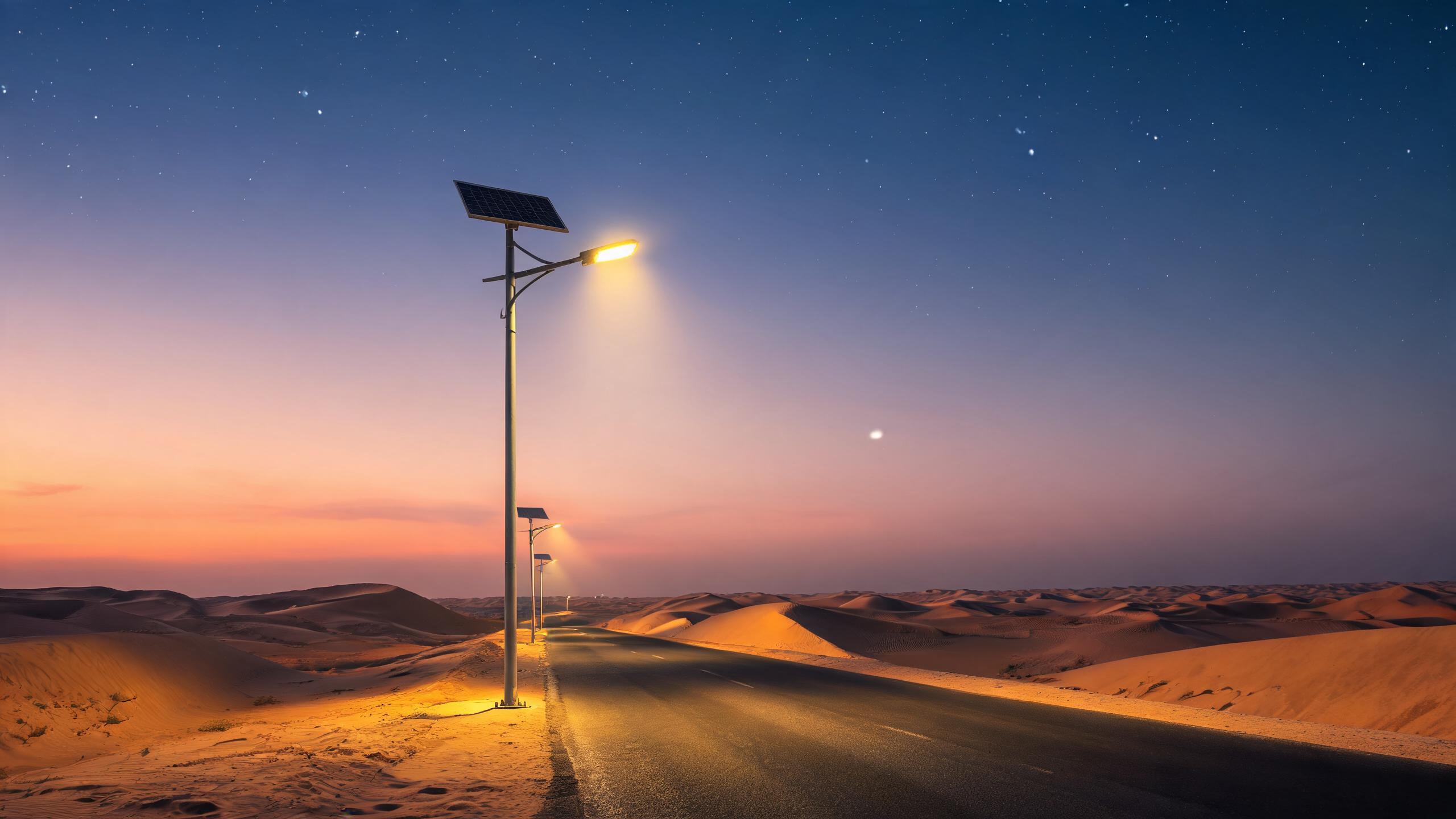
Saudi Arabia has 30,000+ km of rural roads. Many pass through areas with no grid connection — desert highways between cities, agricultural areas in Al-Ahsa, coastal developments on the Red Sea, and new residential communities emerging under Vision 2030. Running a grid connection to these sites costs $50,000+ per kilometer. Solar LED street lighting eliminates that cost entirely.
But the desert is a harsh environment for solar. Dust, extreme heat, and long summer nights create conditions that kill cheap solar fixtures within months. This guide covers what actually works.
All-in-One vs Split Design
All-in-One (Integrated)
Battery, solar panel, LED chip, and controller are integrated into one compact unit mounted on top of the pole. Installation takes 30 minutes — bolt the pole, attach the fixture, turn it on. No wiring, no junction boxes, no electrical contractor.
Pros: Fast installation, compact aesthetics, lower cost ($200-500 per unit). Cons: Battery is inside the fixture at the top of the pole — exposed to the highest temperatures. Replacement requires lowering the pole or using a cherry picker. Limited battery capacity (typically 40-80Ah).
Split Design (Separate Panel + Battery Box)
Solar panel mounts on top. LED fixture mounts at the correct lighting height. Battery and controller sit in a ground-level or mid-pole compartment.
Pros: Larger panel area, larger battery (100-200Ah), battery at ground level (cooler, easier maintenance). Cons: Higher installation cost (wiring required), higher total cost ($400-900 per unit), more components to maintain.
| Factor | All-in-One | Split |
|---|---|---|
| Installation | 30 min, no wiring | 4-6 hours, requires electrician |
| Battery temperature | 50-70°C (top of pole) | 35-45°C (ground box) |
| Battery size | 40-80Ah LiFePO4 | 100-200Ah LiFePO4 |
| Battery replacement | Lower pole or cherry picker | Open ground box |
| Cost per unit | $200-500 | $400-900 |
| Best for | Low-traffic roads, compounds, parking | Highways, main roads, critical lighting |
For most Saudi rural road applications, all-in-one is sufficient. For highway-class lighting (12m+ poles, high lux requirements), split design is necessary.
Battery Chemistry: Why LiFePO4 is the Only Choice
Three battery chemistries appear in solar street lights:
| Chemistry | Cycles (at 80% DoD) | Temp Range | Verdict for KSA |
|---|---|---|---|
| Lead-Acid (AGM) | 300-500 | -10 to 40°C | Unacceptable. Dies in heat within 1 year. |
| Lithium-ion (NMC) | 800-1,200 | 0 to 45°C | Marginal. Thermal runaway risk above 60°C. |
| LiFePO4 (LFP) | 2,000-4,000 | -20 to 60°C | The only choice. 6-10 year lifespan in Saudi conditions. |
LiFePO4 costs 30-40% more upfront but lasts 3-5× longer. The cost per cycle is $0.02-0.04 for LFP vs $0.10-0.15 for lead-acid. In a 100-unit installation over 8 years, the savings on battery replacement alone exceed $40,000.
Verify the battery chemistry on the spec sheet. "Lithium battery" is not LiFePO4 — it's often NMC or worse. The spec sheet must explicitly state "LiFePO4" or "Lithium Iron Phosphate."
Autonomy: How Many Cloudy/Dusty Days?
Autonomy is the number of days the light operates without any solar charging. In Saudi Arabia, the issue isn't clouds — it's dust storms. A shamal can coat the solar panel in dust, reducing charging efficiency by 60-80% for 3-5 days until rain or manual cleaning restores output.
Recommended autonomy by region:
- Riyadh region: 3-4 days (frequent shamals, no rain for months)
- Eastern Province (Dammam, Al-Ahsa): 3 days
- Western region (Jeddah, Madinah): 2-3 days (occasional rain, coastal humidity helps panel cleaning)
- Northern borders (Tabuk, Arar): 4-5 days (severe dust, occasional winter clouds)
- Southern region (Abha, Jazan): 2 days (monsoon influence, regular rain)
More autonomy means larger battery, which means higher cost. The sweet spot for most Saudi applications is 3 days. This requires a battery capacity of:
Battery capacity (Wh) = Daily consumption (Wh) × Autonomy days ÷ DoD (0.8 for LiFePO4)
For a 60W LED running 10 hours/night (600Wh/day) with 3-day autonomy: 600 × 3 ÷ 0.8 = 2,250Wh. A 24V system needs ~94Ah. Round up to 100Ah.
Panel Sizing and Orientation in Saudi Arabia
Saudi Arabia sits between latitudes 16°N and 32°N. Solar panels should face south (azimuth 180°) with a tilt angle equal to the site latitude. Riyadh at 24.7°N: tilt 25° south. Jeddah at 21.5°N: tilt 22° south.
Panel wattage must produce enough energy in one day to replenish the nightly consumption plus account for system losses (controller efficiency ~95%, battery round-trip ~90%, temperature derating ~85% in summer). Rule of thumb: panel wattage = daily consumption ÷ (peak sun hours × 0.7).
Saudi peak sun hours: 5.5-6.5 hours/day (among the highest globally). For 600Wh daily consumption: 600 ÷ (5.5 × 0.7) = 156W. Use a 180W panel minimum to account for degradation and dust.
Desert-Specific Challenges
Dust Accumulation on Panels
Dust can reduce panel output by 1-2% per day during shamal season. Over 30 days without cleaning, output drops 30-60%. Solutions: specify panels with anti-soiling coating (reduces dust adhesion), schedule monthly cleaning (water truck or manual wipe), or choose fixtures with steeper panel angles (30°+) where gravity helps dust slide off.
High Temperature Effects on Panels
Solar panel output drops 0.4%/°C above 25°C. Panel surface temperature in Saudi summer reaches 70-85°C, reducing output by 18-24%. Specify panels with low temperature coefficient (-0.35%/°C or better) and ensure the battery capacity accounts for summer derating.
Sand Abrasion
Windblown sand abrades the panel glass surface over time, creating micro-scratches that reduce transparency. Tempered low-iron glass (3.2mm+) resists abrasion better than standard glass. Ask for the panel's glass thickness and type.
Battery Temperature at Pole Top
All-in-one fixtures have the battery at the top of the pole — the hottest point. Battery compartment temperatures can reach 60-70°C in summer. LiFePO4 degrades faster at these temperatures: a battery rated for 3,000 cycles at 25°C may deliver only 1,500-2,000 cycles at 60°C. Specify fixtures with thermal isolation between LED and battery compartments, and ask for the battery temperature specification.
Planning a solar street lighting project?
Send us your road length, location, and pole height. We'll size the battery, panel, and fixture for your specific Saudi location.
Get Free Solar SizingSmart Features Worth Specifying
- Radar motion sensor: Dims to 30% when no traffic, ramps to 100% when vehicle approaches. Extends battery life by 40-60%.
- Light sensor: Automatic dusk-to-dawn operation. No timer adjustments needed.
- Remote control: Handheld remote to adjust brightness, timing, and mode. Useful for seasonal adjustments.
- Controller with MPPT: MPPT (Maximum Power Point Tracking) extracts 15-30% more energy from the panel than PWM controllers. Essential for dusty conditions where every watt counts.
- Over-temperature protection: Reduces brightness or shuts down when battery exceeds 65°C. Extends battery life at the cost of some dark nights during extreme heat.
Procurement Checklist for Saudi Solar Street Lighting
- Battery chemistry explicitly stated as LiFePO4 (not "lithium" or "Li-ion")
- Battery capacity sized for 3-day autonomy minimum (4+ for northern regions)
- Panel wattage ≥ daily consumption ÷ (5.5 × 0.7)
- Panel glass: tempered low-iron, 3.2mm+
- Panel temperature coefficient ≤ -0.40%/°C
- Controller type: MPPT (not PWM)
- Battery compartment thermally isolated from LED compartment
- IP65 minimum (IP66 for coastal areas)
- Radar motion sensor for energy savings
- Over-temperature protection (shuts down at 65°C battery)
- 3-year warranty minimum (battery 2+ years)
- Panel tilt adjustable to site latitude (16°-32°N)
Solar street lighting works in Saudi Arabia — the country has the highest solar irradiance in the GCC. But only if the system is engineered for dust, heat, and long nights. Specify correctly, and the lights run maintenance-free for 6-8 years. Specify poorly, and you'll be replacing batteries every 18 months.