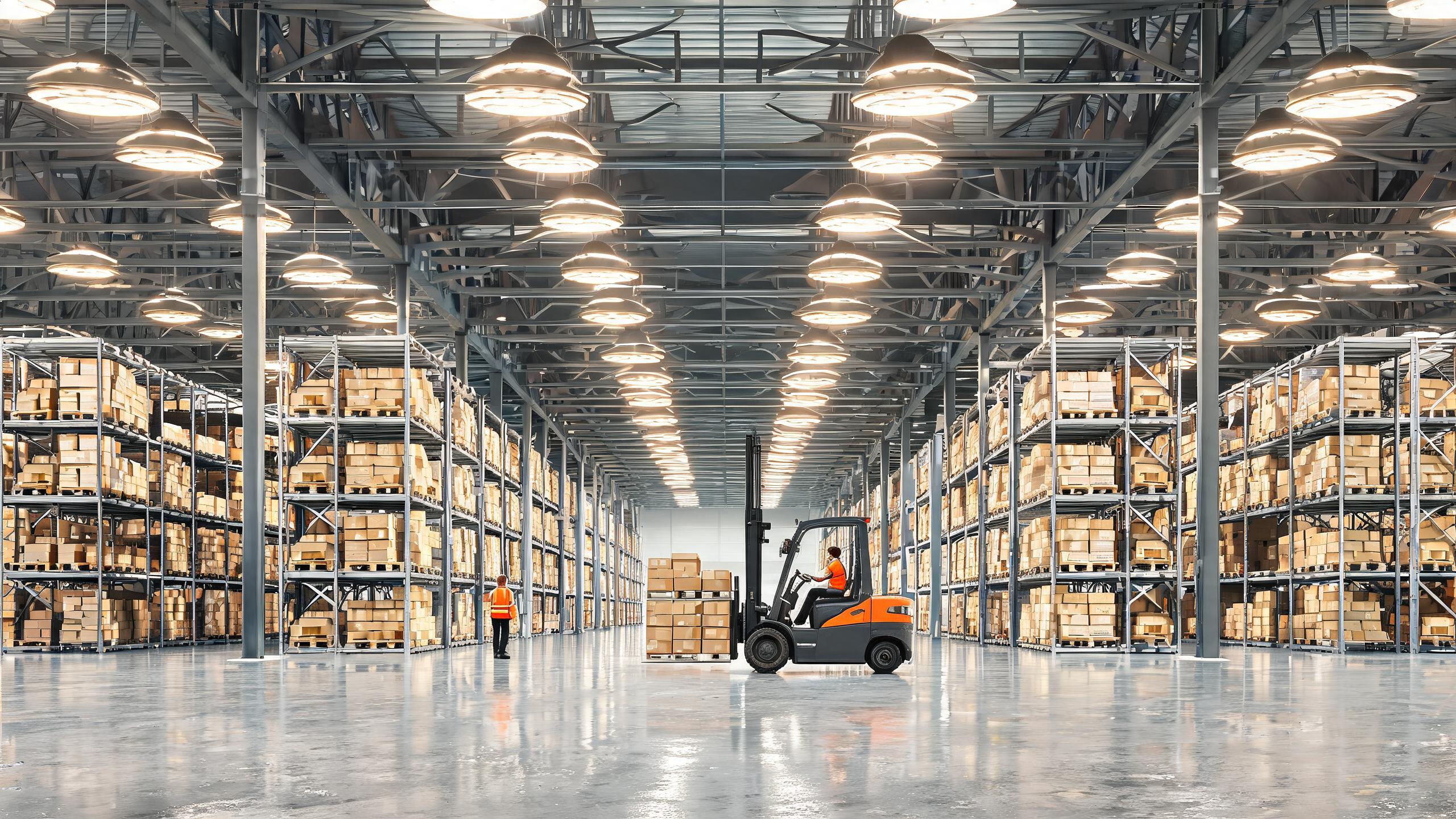
Saudi Arabia and the UAE are pouring billions into logistics infrastructure. Neom's logistics zone, Dubai's expansion of Jebel Ali port, Qatar's Hamad port hinterland — all need warehouse space, and all need lighting that works at 45°C ambient with dust settling on every surface.
If you're specifying lighting for a distribution center, cold storage, or fulfillment warehouse in the GCC, the decisions you make in the procurement phase determine maintenance costs for the next decade. This guide breaks down the numbers.
Lux Levels: What Standard Are You Designing To?
EN 12464-1 and the Saudi Building Code (SBC 501) both address industrial lighting. For warehouses, the key numbers:
| Zone Type | Maintained Lux | UGR (Glare) |
|---|---|---|
| Bulk storage aisles | 150 lux | ≤22 |
| Picking aisles (medium-size items) | 300 lux | ≤22 |
| Picking aisles (small items) | 500 lux | ≤19 |
| Packing and dispatch | 500 lux | ≤19 |
| Loading bays | 200 lux | ≤22 |
These are maintained values — meaning the light level at the end of the maintenance cycle, not on day one. You need to account for lumen depreciation (L70 at 50,000 hours is standard) and dirt accumulation. In dusty GCC environments, a maintenance factor of 0.7 is realistic, not the 0.8 that European suppliers assume.
UFO High Bay vs Traditional High Bay: Why Shape Matters
The UFO (saucer-shaped) design has largely replaced traditional linear high bays for one practical reason: heat dissipation. The circular fin structure provides more surface area per unit of weight, which matters when your ambient temperature is already 40-50°C. A fixture that runs cooler means slower lumen depreciation and longer driver life.
For a typical 12-meter ceiling height in a GCC logistics hub:
- 100W UFO — covers ~25m² at 12m mounting height, achieves 150+ lux for bulk storage
- 150W UFO — covers ~30m² at 12m, achieves 200+ lux for loading bays
- 200W UFO — covers ~25m² at 10m, achieves 300+ lux for picking aisles
- 300W UFO — covers ~30m² at 8m, achieves 500 lux for small-item picking
These figures assume 150 lm/W efficacy, 120° beam angle, and a 0.7 maintenance factor. If your supplier quotes 160+ lm/W, verify with a photometric test report — inflated efficacy numbers are common in the Chinese export market.
Spacing and Layout: Don't Guess, Calculate
The maximum spacing between high bay fixtures depends on mounting height and beam angle. A common rule of thumb: spacing = 1.5 × mounting height for a 120° beam. But this is a starting point, not a design.
For a warehouse with 12m ceilings and 120° beam UFO high bays:
- Maximum spacing: ~6m between fixtures
- Edge distance: ≤3m from walls
- Uniformity ratio (min/avg): ≥0.6 for storage, ≥0.7 for picking
Always request a DIALux simulation from your supplier before committing to a layout. A reputable manufacturer will provide this free of charge and include point-by-point lux calculations, uniformity ratios, and a 3D rendering.
Middle East-Specific Considerations
Dust and IP Rating
Warehouse environments in the GCC deal with fine particulate dust that infiltrates everything. IP65 minimum is non-negotiable. IP66 is better for facilities near loading docks where pressure washing occurs. Check that the IP rating applies to the entire fixture — not just the lens — because dust settling on the driver enclosure causes thermal failure.
Ambient Temperature Derating
Most LED high bays are rated for 25°C ambient (the IEC standard). At 45°C — common in a GCC warehouse with limited ventilation — driver output drops and lifespan shortens. Specify fixtures with a stated Tc (case temperature) rating of at least 65°C, and ask for the L70 curve at 45°C ambient. If the manufacturer can't provide this, walk away.
Surge Protection
GCC power grids, especially in industrial zones and new development areas, experience voltage spikes. Specify high bays with built-in 4kV surge protection. For areas with known grid instability, add a 10kV surge protection device at the distribution panel.
Smart Controls and Occupancy Sensors
Warehouses are perfect for occupancy-based dimming. A high bay that dims to 20% when the aisle is empty and ramps to 100% when a forklift enters saves 60-70% on energy. Microwave sensors work better than PIR in industrial environments because they detect motion through racking and don't require line of sight.
Energy Savings: A Real Calculation
Consider a 5,000m² warehouse in Riyadh, currently lit with 400W metal halide high bays at 12m, 150 lux average:
- Existing: 67 × 400W MH = 26.8 kW, running 12h/day = 321.6 kWh/day
- LED replacement: 67 × 150W UFO = 10.05 kW, running 12h/day = 120.6 kWh/day
- Daily savings: 201 kWh/day × SAR 0.38/kWh (industrial tariff) = SAR 76/day
- Annual savings: SAR 27,740 (~$7,400)
- With occupancy dimming (70% reduction): Additional SAR 19,418/year
- Total annual savings: ~SAR 47,158 (~$12,600)
At an installed cost of $40-60 per fixture (150W UFO, IP65, 150 lm/W), the payback period for 67 fixtures is 4-6 months without occupancy sensors, and 3-4 months with sensors installed.
Need a DIALux simulation for your warehouse?
Send us your floor plan and ceiling height. We'll provide a free lighting design with fixture count, layout, and lux calculations within 48 hours.
Request Free Lighting DesignProcurement Checklist for GCC Warehouse Lighting
- 150+ lm/W efficacy confirmed by photometric test report
- IP65 or IP66 rated (entire fixture, not just lens)
- L70 ≥ 50,000 hours at 45°C ambient (not 25°C)
- Built-in 4kV surge protection
- Tc rating ≥ 65°C
- 5-year warranty covering driver and LED chips
- DIALux simulation provided before purchase
- SASO registration and SABER platform compliance
- Microwave sensor compatibility (for occupancy dimming)
- 100-277V wide voltage input
Get these ten items right and your warehouse lighting will perform for a decade with minimal maintenance. Get any of them wrong and you'll be on a scissor lift replacing drivers in 18 months — at 45°C, in a dusty warehouse, during peak season.