Choosing the right dimming protocol for LED commercial lighting affects energy savings, user comfort, and project cost. For Middle East projects — where hotels, offices, and retail spaces demand precise lighting control — the choice between DALI and 0-10V dimming is a common specification question.
This guide compares both protocols across 7 dimensions to help specifiers, contractors, and project managers make informed decisions.
What is 0-10V Dimming?
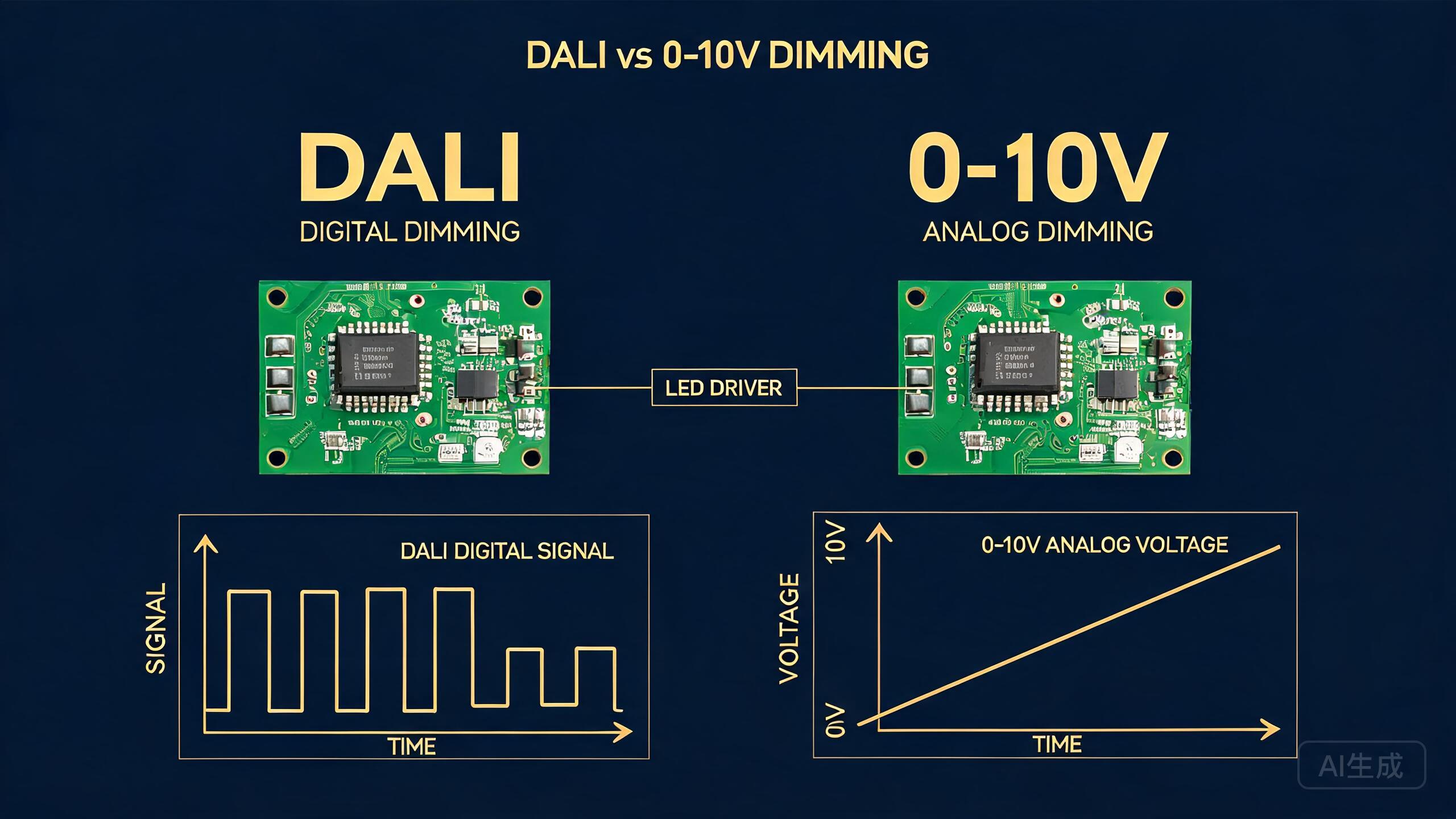
0-10V dimming is an analog lighting control protocol standardized under IES EL-7-A. It uses a low-voltage DC signal (0-10 volts) to control LED output:
- 10V = 100% brightness
- 1V = 10% brightness (minimum)
- 0V = Off (or minimum, depending on driver)
0-10V Key Characteristics
| Parameter | Specification |
|---|---|
| Signal type | Analog DC voltage |
| Wiring | 2-wire (positive + negative) |
| Topology | Bus, one-way communication |
| Dimming range | 10%-100% (some drivers: 1%-100%) |
| Minimum dimming level | Typically 10% |
| Group control | All fixtures on same circuit dim together |
| Wiring distance | Up to 300m (with proper wire gauge) |
| Cost per fixture | Low (simple driver circuitry) |
What is DALI Dimming?
DALI (Digital Addressable Lighting Interface) is a digital lighting control protocol standardized under IEC 62386. Each DALI driver has a unique address, enabling individual fixture control.
DALI Key Characteristics
| Parameter | Specification |
|---|---|
| Signal type | Digital Manchester-encoded |
| Wiring | 2-wire (polarity-independent) |
| Topology | Bus, two-way communication |
| Dimming range | 0.1%-100% |
| Minimum dimming level | 0.1% (16-bit resolution) |
| Group control | Up to 16 groups, 64 individual addresses per bus |
| Wiring distance | Up to 300m total bus length |
| Cost per fixture | Higher (digital controller + DALI driver) |
Head-to-Head Comparison
1. Control Flexibility
0-10V: All fixtures on the same circuit dim together. You cannot control individual fixtures. If you need zone control, you need separate 0-10V circuits for each zone — adding wiring complexity.
DALI: Each fixture has a unique address. You can control individual fixtures, create groups, set scenes, and schedule automatic dimming — all from a single bus. A hotel ballroom with 50 DALI fixtures can have 10 different lighting scenes programmable from a single controller.
Winner: DALI — for projects requiring zone control, scene setting, or individual fixture addressing.
2. Wiring Complexity
0-10V: Requires 2 extra wires alongside power lines. Simple point-to-point or daisy-chain topology. Electricians familiar with basic low-voltage wiring can install without special training.
DALI: Also uses 2 wires, but polarity-independent (can connect either way). However, DALI requires a bus controller and proper bus power supply. Installation requires basic DALI protocol knowledge.
Winner: 0-10V — simpler installation, lower labor cost, no special training needed.
3. Dimming Performance
0-10V: Minimum dimming to 10% on most drivers. Some premium drivers achieve 1%. Dimming curve is linear but may show steps at low levels.
DALI: Minimum dimming to 0.1% with 16-bit resolution (256 steps). Smooth, logarithmic dimming curve matches human eye perception. No visible stepping.
Winner: DALI — smoother dimming, lower minimum level, better for hospitality and luxury applications.
4. Cost Comparison
| Cost Component | 0-10V | DALI |
|---|---|---|
| LED Driver (per fixture) | $3-8 premium | $8-15 premium |
| Bus controller | Not required | $50-200 per bus |
| Wall dimmer/panel | $20-100 | $50-300 (DALI panel) |
| Installation labor | Standard | +10-15% (DALI programming) |
| Total system cost (50 fixtures) | ~$200-600 premium | ~$600-1,500 premium |
Winner: 0-10V — 50-70% lower system cost than DALI.
5. Reliability and Maintenance
0-10V: Analog signal is susceptible to voltage drop over long distances. If the control wire is damaged, all fixtures default to 100%. No feedback or status reporting.
DALI: Digital signal is more robust. If the bus is interrupted, fixtures remember their last state. DALI supports two-way communication — the system can report fixture failures, driver status, and energy consumption.
Winner: DALI — fault tolerance, status reporting, and remote diagnostics.
6. Scalability
0-10V: Adding fixtures means adding them to the existing circuit. No individual addressing means no way to control new fixtures independently.
DALI: Up to 64 addresses per bus. Multiple buses can be gatewayed together for large installations (up to 64 buses = 4,096 fixtures). Future expansion is straightforward — just assign a new address.
Winner: DALI — designed for large-scale, multi-zone installations.
7. Integration with Building Management Systems (BMS)
0-10V: Integration requires analog-to-digital converters or relay panels. Limited data exchange — the BMS can only send dim commands, not receive fixture status.
DALI: Native integration with BACnet, KNX, and Modbus via DALI gateways. Full bidirectional communication — the BMS can query fixture status, energy usage, and failure alerts.
Winner: DALI — full BMS integration, essential for smart buildings.
Which Protocol Should You Choose?
Choose 0-10V When:
- Budget-conscious projects: Retail chains, small offices, warehouses
- Simple on/off + dim: Applications where all fixtures dim together
- No scene programming needed: Corridors, storage areas, parking garages
- Local electricians: No DALI-qualified installers available
- Quick installation: Fast-track projects with tight deadlines
Choose DALI When:
- Hotels and hospitality: Multiple scenes per room (welcome, reading, sleep, cinema)
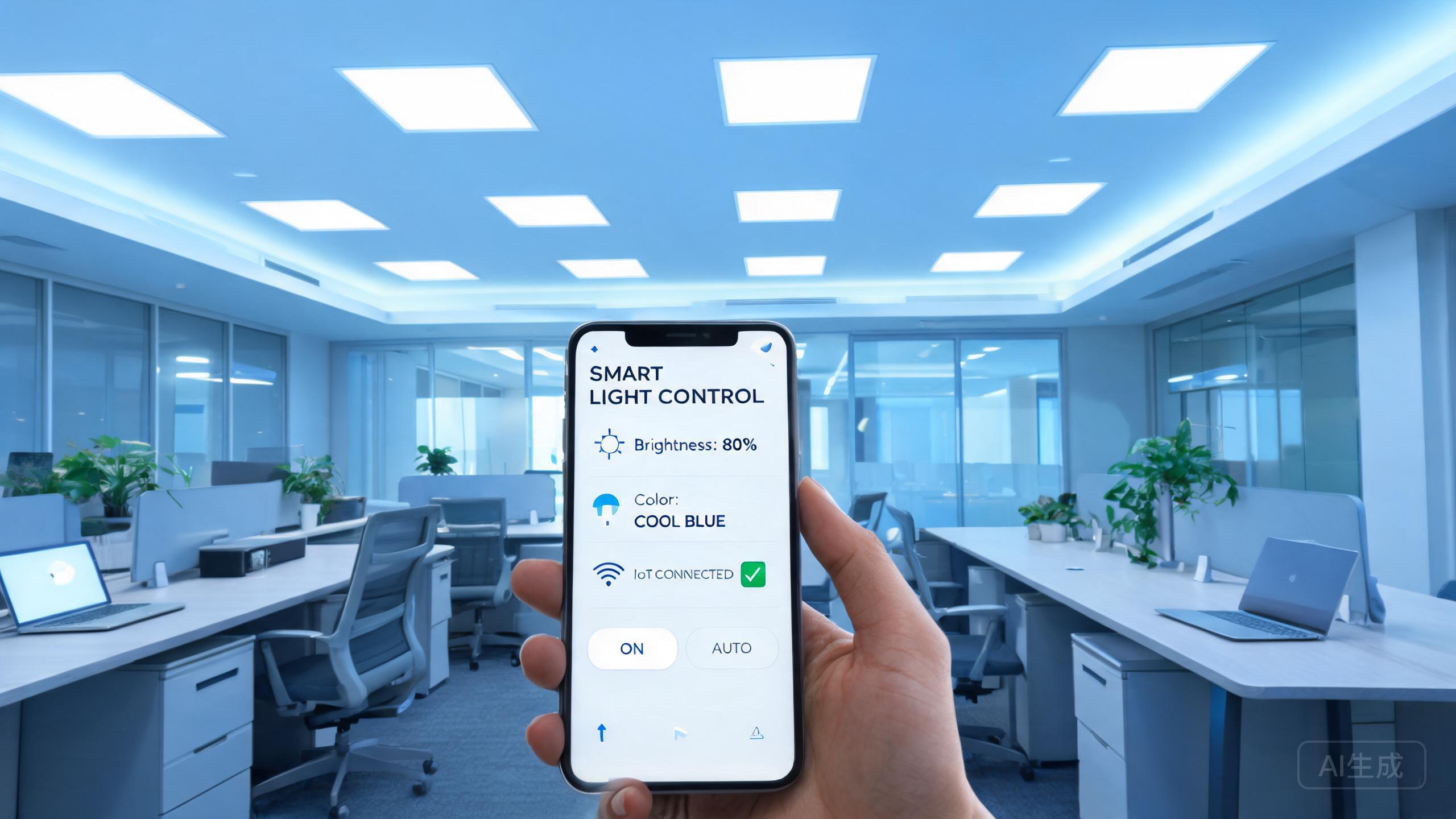
- Office buildings: Daylight harvesting with individual fixture control
- Retail and showrooms: Accent lighting with precise beam control and dimming
- Large installations: 50+ fixtures with zone management
- Smart buildings: BMS-integrated projects requiring status reporting
- Luxury projects: Where 0.1% dimming smoothness matters
Middle East Specific Considerations
High Temperature Impact
Both protocols use low-voltage signals (typically 15-30V DC for 0-10V, 16V DC for DALI). In Middle East environments where ambient temperatures can reach 50°C+:
- 0-10V: Voltage drop increases with temperature. For runs over 100m in hot environments, use 14AWG or thicker wire to maintain signal integrity.
- DALI: Digital signal is more tolerant of voltage variations. However, DALI bus power supplies should be rated for 70°C+ ambient operation.
Sand and Dust
Corrosion on control wiring terminals is a risk in dusty environments. Both protocols benefit from sealed junction boxes (IP54+). DALI’s polarity-independent wiring is advantageous — incorrect polarity in dusty, low-visibility conditions is a common installation error with 0-10V.
Voltage and Frequency
Middle East electrical systems use 220-240V, 50Hz. Both 0-10V and DALI drivers are widely available in 220-240V input versions. Yakeen Lighting provides both dimming options across all product categories, with drivers rated for 170-264V input to handle GCC voltage fluctuations.
Yakeen Lighting Dimming Support
Yakeen Lighting offers both dimming protocols across its product range:
| Product Category | 0-10V | DALI | TRIAC | Other |
|---|---|---|---|---|
| LED Downlight | ✅ | ✅ | ✅ | — |
| LED Track Light | ✅ | ✅ | — | — |
| LED Panel Light | ✅ | ✅ | — | Push DIM |
| LED Linear Pendant | ✅ | ✅ | — | — |
| Magnetic Track System | ✅ | ✅ | — | RF 2.4G |
| UFO High Bay | ✅ | ✅ | — | — |
| LED Flood Light | ✅ | — | — | — |
| Solar Street Light | — | — | — | Microwave sensor |
| Wall Washer | ✅ | ✅ | — | DMX512 |
| LED Spotlight | — | — | ✅ | — |
Conclusion
For most Middle East commercial lighting projects, 0-10V dimming is sufficient for simple applications (corridors, warehouses, retail chains), while DALI is the better choice for complex, multi-zone installations (hotels, offices, smart buildings). The cost difference is typically 50-70% higher for DALI, but the flexibility, scene programming, and BMS integration capabilities justify the investment for hospitality and premium commercial projects.
Yakeen Lighting supports both protocols across 10 product categories, with SASO and G-Mark certified drivers rated for 50°C+ Middle East conditions. Contact [email protected] or WhatsApp +86-181-0343-4722 for project-specific dimming recommendations.