High-Temperature LED Lighting Solutions for Middle East Climates
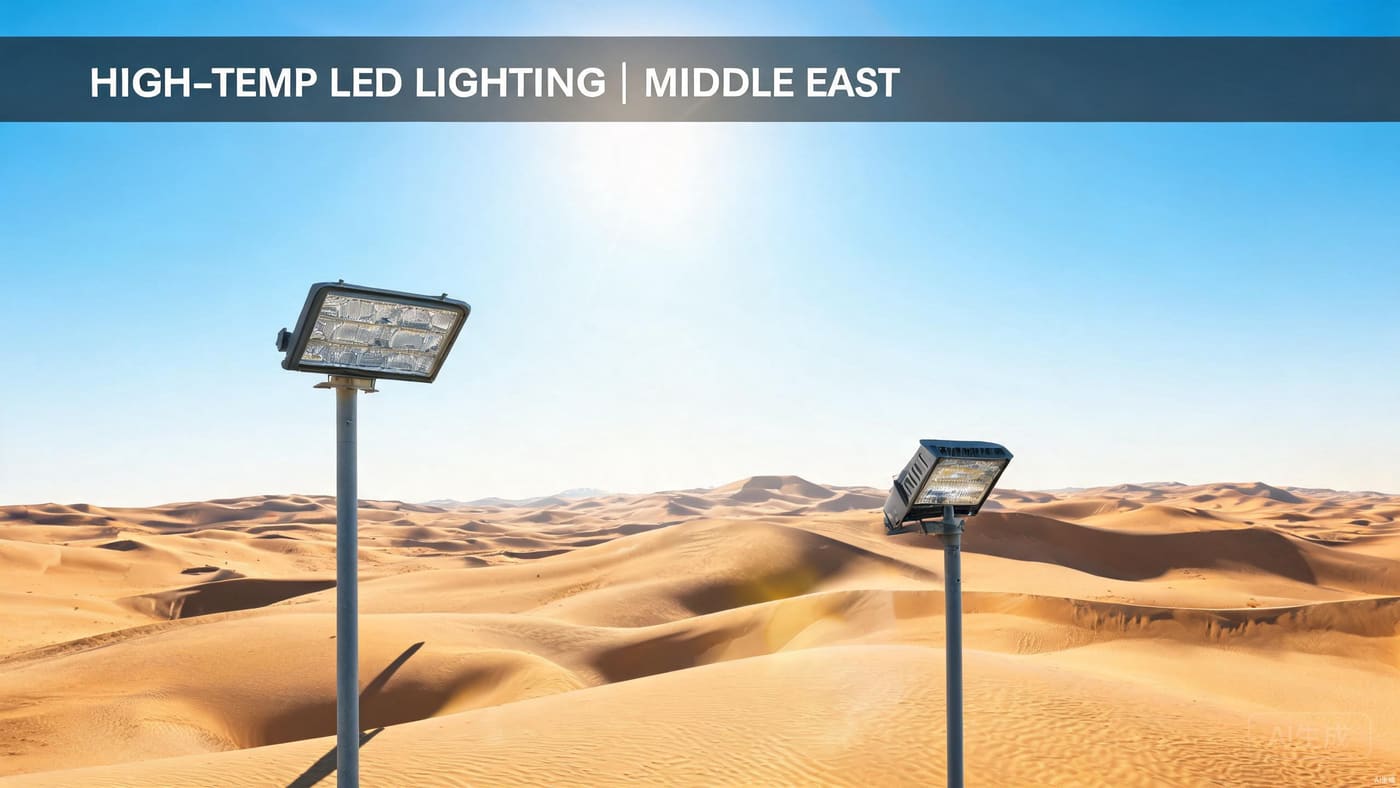
LED lighting installed in Middle East outdoor environments must withstand ambient temperatures exceeding 50°C, intense UV radiation, and abrasive sand dust. Standard LED products designed for European or North American climates will fail prematurely in GCC conditions. This guide explains the engineering requirements and selection criteria for reliable high-temperature LED lighting.
Why Standard LEDs Fail in the Middle East
LED performance and lifespan are directly tied to junction temperature. The IEC standard reference ambient for LED testing is 25°C. In the Middle East:
- Summer ambient: 45-55°C (shade), 65°C+ (direct sun on fixture)
- Roof/ceiling temperature: 70-80°C in direct sunlight
- Sand storm conditions: Abrasive particles + humidity cycling
- UV index: 11+ (extreme) for 6+ months per year
At 55°C ambient, a standard LED driver rated for 40°C maximum will:
- Lose 20-30% of rated lifespan
- Experience thermal shutdown (intermittent failure)
- Suffer capacitor degradation (permanent failure within 12-18 months)
Key Engineering Requirements
1. Thermal Management
LED Chip Junction Temperature (Tj)
- Must stay below 110°C at maximum ambient (IEC 62717)
- Requires oversized heat sink (40-60% larger than temperate climate design)
- Aluminum die-cast housing with thermal conductivity >96 W/m·K
LED Driver Temperature Rating (tc)
- Minimum tc 65°C (most standard drivers are tc 55-60°C)
- Silicone potting compound (not epoxy — silicone survives thermal cycling)
- Premium brands: Mean Well HLG/ELG series, Inventronics EUM series
Thermal Interface Material
- High-grade thermal paste (thermal conductivity >3 W/m·K)
- Avoid thermal pads — they degrade at sustained high temperatures
2. UV Resistance
Middle East sun delivers extreme UV radiation that degrades LED materials:
| Component | Standard Product | Middle East Product |
|---|---|---|
| Lens/cover | Standard PC (yellowing in 2 years) | UV-stabilized PC or tempered glass |
| Housing coating | Standard powder coat | PVDF coating (25-year UV warranty) |
| Gaskets | Standard EPDM | Silicone gaskets (UV-resistant) |
| Cable jacket | PVC | XLPE or cross-linked PO |
3. Dust and Sand Ingress (IP Rating)
Sand dust in the Middle East is extremely fine (sub-10 micron) and penetrates standard IP65 fixtures:
- Minimum IP rating: IP66 for outdoor fixtures
- Recommended: IP67 for all exterior lighting
- Gasket design: Multi-lip silicone seal (not single O-ring)
- Breather valve: GORE-TEX pressure equalization valve to prevent vacuum dust ingress
- Ik rating: IK10 for fixtures in public areas (impact resistance)
4. Electrical Protection
Middle East power grids experience voltage fluctuations:
- Input voltage range: 170-264V AC (wider than standard 220V ±10%)
- Surge protection: 10kV surge protection device (SPD) built into driver
- Power factor: >0.95 at full load
- THD: <15% to avoid grid harmonic issues
Product Selection Matrix by Application
| Application | Recommended Product | Key Specs | Expected Lifespan |
|---|---|---|---|
| Outdoor wall/facade | LED Flood Light | IP67, IK10, tc65°C, PVDF | L70 >50,000h |
| Street lighting | LED Road Light | IP67, IK10, 150lm/W, tc65°C | L70 >60,000h |
| Industrial/warehouse | UFO LED High Bay | IP65, tc65°C, 150°C rated cap | L70 >50,000h |
| Canopy/parking | LED Canopy Light | IP66, tc65°C, sealed driver | L70 >50,000h |
Testing and Validation
Before specifying LED products for Middle East projects, verify:
- IEC 60598-1 thermal test: Pass at 50°C ambient (not just 25°C)
- IEC 60068-2-2 (dry heat): 70°C for 96 hours — no degradation
- IEC 60068-2-78 (damp heat): 40°C / 93% RH for 96 hours
- IEC 60068-2-68 (sand dust): L2 test — no ingress
- UV aging test: 1,000 hours UV-B exposure — no yellowing >ΔYI 3
Common Failure Modes in Hot Climates
Driver Failure (60% of failures)
- Cause: Electrolytic capacitor drying at high temperature
- Symptom: Flickering → intermittent → dead
- Prevention: tc65°C rated driver, 105°C capacitors, silicone potting
LED Chip Degradation (25% of failures)
- Cause: Sustained high junction temperature reduces lumen output
- Symptom: 30-50% lumen depreciation in 12 months
- Prevention: Oversized heat sink, lower drive current (350mA vs 500mA)
Lens Yellowing (10% of failures)
- Cause: UV degradation of polycarbonate lens
- Symptom: Reduced light output, color shift
- Prevention: UV-stabilized PC or glass lens
Seal Failure (5% of failures)
- Cause: Thermal cycling degrades gaskets
- Symptom: Moisture/dust ingress → short circuit
- Prevention: Silicone gaskets, GORE-TEX breather valve
How Yakeen Lighting Addresses High-Temperature Challenges
All Yakeen Lighting outdoor products are engineered for Middle East climates:
- tc65°C rated drivers (Mean Well HLG/ELG series)
- Oversized aluminum heat sinks (40%+ larger than standard)
- UV-stabilized housings with PVDF coating option
- IP67 rating with multi-lip silicone gaskets
- 10kV surge protection built into every outdoor fixture
- 170-264V wide input voltage range
- 5-year warranty (including solar battery: 3 years)
- SASO and G-Mark certified for GCC compliance
Contact us for high-temperature rated LED lighting products tested for Middle East conditions.
References
- IEC 60598-1: Luminaires — General requirements and tests
- IEC 62717: LED modules for general lighting — Performance requirements
- IEC 60068-2-2: Environmental testing — Dry heat
- LM-80: LED package lumen maintenance
- GSO 25: GCC Technical Regulation for Lamps and Luminaires