A supplier quotes $2.50 per LED downlight. Another quotes $5.00. The instinct is to choose the cheaper one — but the unit price is only the beginning of the cost story. By the time the lights are installed and working, the “cheap” option often costs more.
This guide breaks down the Total Cost of Ownership (TCO) for imported LED lighting, with real numbers from Middle East procurement scenarios.
The Hidden Costs Behind a Low Unit Price
1. Defect Rate
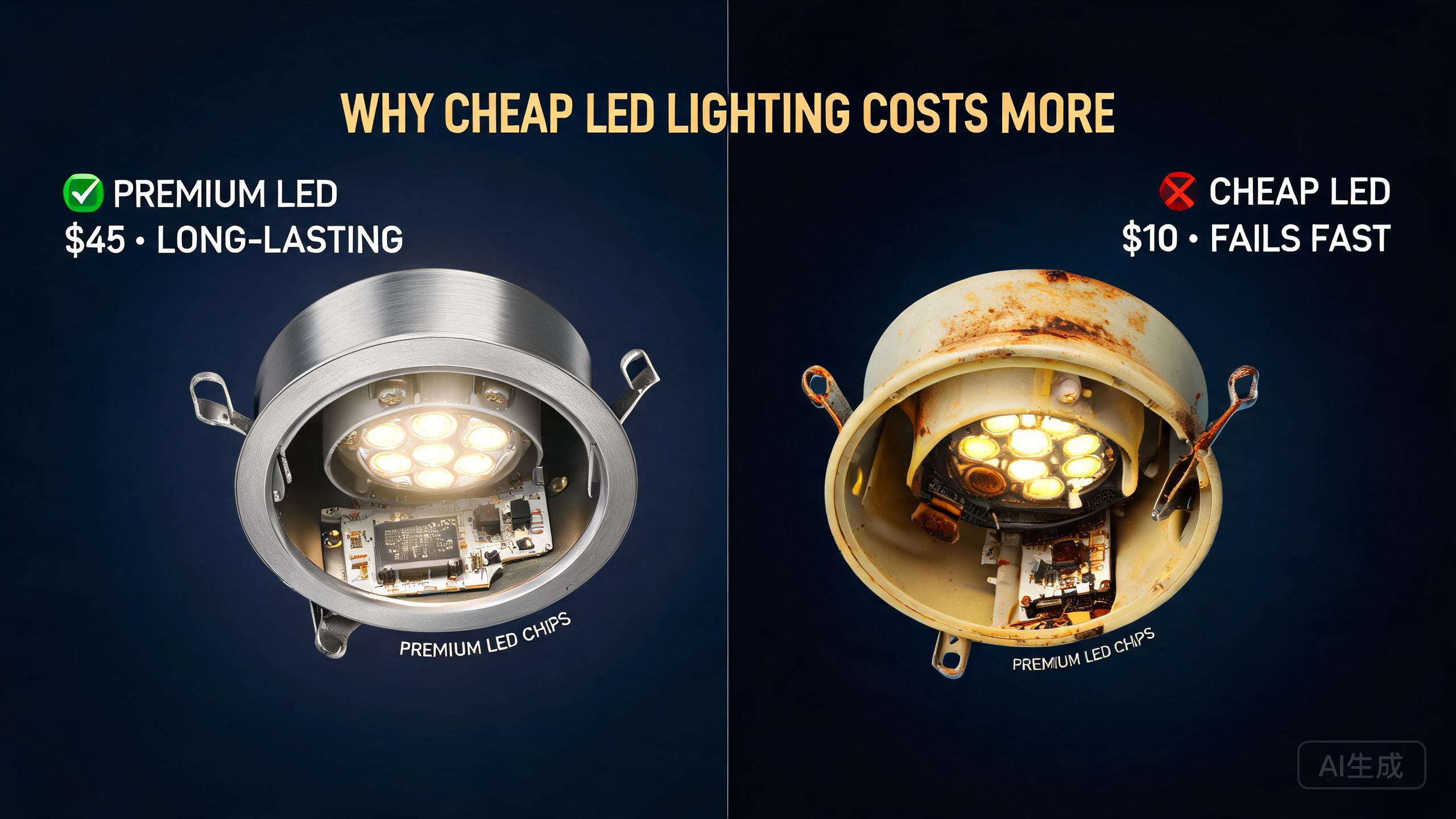
The most underestimated cost in LED procurement. A cheap supplier cuts corners on: LED chip quality, driver components, soldering, thermal paste, and aging tests. The result is a higher percentage of fixtures that fail before or shortly after installation.
| Quality Level | Typical Defect Rate | Cost Impact (per 1,000 units at $3/pc) |
|---|---|---|
| Premium (ISO 9001, LM-80 chips) | <0.5% | 5 dead units = $15 lost |
| Standard (CE/RoHS, name-brand chips) | 1-3% | 10-30 dead units = $30-90 lost |
| Budget (unbranded, no testing) | 5-12% | 50-120 dead units = $150-360 lost |
| Bottom (no QC, rejected batches resold) | 15-25% | 150-250 dead units = $450-750 lost |
The math: 1,000 downlights at $2.50/pc with 10% defect rate = $250 in dead units. Add replacement shipping, labor, and customer dissatisfaction — the real cost per working unit jumps from $2.50 to $3.15+.
2. Missing Certifications
LED lighting imported into Saudi Arabia requires SABER registration. Into the UAE, it requires ESMA compliance. Into the GCC, G-Mark certification. These are not optional.
| Scenario | Cost |
|---|---|
| Supplier provides SABER-compliant products with test reports | $0 extra (included) |
| Buyer arranges SABER independently | SAR 5,000-14,500 per product model ($1,300-3,900) |
| Shipment arrives without SABER, customs detains it | Port storage: $50-150/day + re-export risk |
A shipment of 2,000 fixtures detained for 3 weeks while SABER is arranged: 21 days × $100/day = $2,100 in storage alone — more than the “savings” from the cheaper supplier.
3. Delivery Delays
Late delivery is not just an inconvenience — it has a real cost:
| Delay Factor | Cheap Supplier | Reputable Supplier |
|---|---|---|
| On-time delivery rate | 60-75% | 95%+ |
| Typical delay when late | 15-30 days | 3-7 days |
| Project delay cost (contractor waiting) | $200-500/day | Minimal |
| 20-day delay cost | $4,000-10,000 | Minimal |
If a contractor is waiting for lights to complete a mall project, a 20-day delay costs more in idle labor and penalties than the entire lighting budget.
4. No After-Sales Support
When a fixture fails 8 months after installation, who replaces it?
| Supplier Type | After-Sales Response |
|---|---|
| Reputable supplier (with QC, traceable batches) | Replacement shipped, root cause analyzed |
| Cheap supplier (anonymous, no QC records) | No response to messages, no replacement |
| Cost of replacement (200 units × $3/pc) | $600 — plus international shipping and installation labor |
5. Inferior Components
Cheap LED lighting uses inferior components that reduce lifespan and performance:
| Component | Premium | Budget |
|---|---|---|
| LED chips | branded (Samsung, Seoul, Epistar) | unbranded, bin rejects |
| Driver | Meanwell, Inventronics | unknown brand, 1-2 year lifespan |
| Heat sink | die-cast aluminum, designed for 50°C ambient | thin aluminum, overheats at 40°C |
| Lens | PMMA optical grade | recycled polystyrene (yellows in 6 months) |
| Housing paint | powder coating, UV resistant | spray paint, chips in humid/salty air |
Lifespan difference: Premium LED fixtures are designed for 50,000+ hours (L70). Budget fixtures may drop below 70% brightness at 10,000-15,000 hours — meaning they need replacement 3-5× more often.
Real-World TCO Calculation
Scenario: 2,000 LED Downlights for a Saudi Commercial Project
| Cost Factor | Budget Supplier ($2.50/pc) | Reputable Supplier ($5.00/pc) |
|---|---|---|
| Unit cost (2,000 pcs) | $5,000 | $10,000 |
| Defect rate (10% vs 0.5%) | 200 dead units = $500 lost | 10 dead units = $50 lost |
| SABER registration | $2,600 (self-arranged) | $0 (included) |
| DIALux lighting design | $800 (hired designer) | $0 (included) |
| QC inspection | $400 (third-party SGS) | $0 (included in process) |
| Delivery delay risk (20% chance of 20-day delay) | $1,600 expected cost | $200 expected cost |
| Replacement units (8 months later, 5% failure) | $250 + shipping | $50 + shipping |
| Export documentation | $300 (agent fee) | $0 (included) |
| Total Cost | $10,850 | $10,300 |
| Cost per working unit | $5.99/pc | $5.17/pc |
The “cheap” supplier at $2.50/pc ends up costing $5.99 per working unit — more than the “expensive” supplier at $5.00/pc ($5.17 per working unit).
And this calculation does not include:
- The buyer’s time managing multiple service providers (lab, designer, QC, agent)
- The risk of customs rejection and total shipment loss
- The reputational damage of a project with flickering or dead lights
- The cost of re-ordering replacement units mid-project
How to Evaluate the Real Cost of a Supplier
When comparing LED lighting suppliers, ask these 8 questions:
1. What is your defect rate?
A supplier who cannot answer this has no QC system. Look for <1% with documented inspection records.
2. Are test reports from recognized labs included?
SASO-recognized labs (Intertek, SGS, TUV) cost money. Suppliers who invest in proper testing have higher prices — but their products pass customs.
3. Is SABER registration support included?
If the supplier expects you to handle SABER yourself, add $1,300-3,900 per product model to your cost calculation.
4. What is your on-time delivery rate?
Ask for a number. Suppliers who track this metric typically have rates above 90%. Those who don’t track it are usually below 75%.
5. What after-sales support do you provide?
Look for: warranty period, replacement policy, response time commitment. A 3-year warranty with 24-hour response is worth real money.
6. What LED chips and drivers do you use?
Branded chips (Epistar, Samsung, Seoul Semiconductor) and drivers (Meanwell, Inventronics) cost more but last longer. Ask for the exact component specifications.
7. Is DIALux lighting design included?
Professional DIALux simulation ensures the right fixture count, placement, and beam angle for your space. Outsourcing this costs $500-2,000 per project.
8. Can I see your QC process?
A supplier with a documented 5-stage QC process (incoming inspection, in-line QC, aging test, final inspection, pre-shipment inspection) will have a lower defect rate than one who simply “tests some samples.”
The Bottom Line
The cheapest LED lighting is rarely the most cost-effective. The total cost of ownership includes unit price, defect rate, certification, design, QC, delivery reliability, and after-sales support — and when all of these are accounted for, a mid-priced supplier with comprehensive service often costs less per working unit than a bottom-priced supplier with no support.
When evaluating suppliers, compare cost per working unit and total project cost — not unit price alone.
About Yakeen Lighting
Yakeen Lighting provides SASO and G-Mark certified LED commercial lighting with:
- <0.5% defect rate (5-stage QC process)
- Full SABER registration support included
- Free DIALux lighting design
- 97%+ on-time delivery rate
- 24-hour quote response time
- LM-80/TM-21 test reports available
- Live factory video tours on request
Contact Yakeen Lighting for a TCO comparison on your next project, or browse our certified product catalog.
For more procurement guidance, read our SABER Registration Guide and Factory Verification Guide.